Monday, January 20, 2014

Innocent Venus

I’m struggling to find series to blog about lately because there just doesn’t seem to be that much good anime out there right now.  Maybe some of the 15 first episodes I’ve downloaded in the last couple of weeks will turn out to be good series.  In the meantime I’m going to pull up another old one, Innocent Venus.


Innocent Venus is a short series which takes place in the post-apocalyptic future and revolves around three characters, two soldiers named Jin and Jou, and a young girl named Sana.  At the start of the anime series the three are running from seemingly everybody, after Jin and Jou have rescued/stolen Sana.  Jin and Jou drive mecha, although not the humongous mecha we’ve all come to know and love.  Their mecha are more man-sized and give their drivers increased fighting capabilities.  Interestingly, every time Jou drives his, he cries afterward – for reasons that are explained later.  Jin doesn't cry after driving his, which also becomes important.

As the series proceeds Jin, Jou and Sana hook up with a street-wise kid named Gora who tags along with them for the rest of the series, mainly for comic relief.  Their little group is mainly being chased by an elite government military agency, but they manage to stay free.  The four of them take refuge on a special submarine/ship which has been taken over and is being run by a former military-captain-gone-rogue named Toraji, and his crew.  Toraji’s former lover is a member of the government military agency that’s out to recapture Sana, just to make things more interesting.

In the middle of the series, Jin betrays everyone and takes Sana and turns her over to the government in exchange for power.  In addition, when his partner Jou questions him, he stabs Jou and leaves him for dead.  Since Jin started out as my favorite character, I spent several episodes in denial, waiting for an explanation or a turnaround.  But no, he’s a bad guy. 
  
It seems the government has been experimenting with new and different and better mecha, as all governments do.  But what’s not known to most people is that the mecha the military drive have a nervous system which came from sacrificed children.  (Thus Jou’s tears when he drives his mecha as he responds to residual feedback from the children. And Jin's lack of tears speaks to his character.)  Sana has the ultimate nervous system for the government's mecha needs and the government wants her back to be able to use it.

Even Sana believes there has to be a reason for Jin’s betrayal, and after she’s rescued by the still-living Jou, she demands they capture Jin so she can talk to him.  But, no, he’s really just a bad guy who wants power.

In the end, the good guys and bad guys have a humongous battle, from which the good guys emerge victorious, destroying the installation responsible for the experiments with children.  In addition, Sana and Jin survive and Toraji's former lover comes over to the good guys' side and back to him.  So despite the fact that my favorite character was a bad guy betrayer, the series has a decent ending and an interesting enough plot to make it entirely watchable.  It was a good short series.  

Saturday, January 4, 2014

Canaan

Today I’m going to post a short blog post about a short series named Canaan.  This series has a fairly unique and interesting plot setup, good music, lots of action, and the characters are pretty to watch.  All that being said, it doesn’t end up on my favorite series list.  I’ll go into the reasons for that as I go along.

The title character of the series, Canaan, is an assassin.  She also happens to be the best friend of a young reporter named Maria.  Maria and Canaan met and became friends years ago and are both in Shanghai for an anti-terrorist conference.  Canaan is also trying to get hold of a particularly nasty virus, called the Ua virus, that has been used in bio-terrorist attacks.


Maria survived an attack using that virus sometime before this series takes place because of a vaccine developed by her virologist father.  She remains a target for bad guy groups and Canaan often protects her.  Other people who have survived the virus without the aid of the vaccine are now referred to as Borners.  Borners survived the virus, but have been mutated by it so that most of them have some sort of special skill.  Unfortunately, they also require a supply of special antiviral medication in order to survive.

So Maria is in Shanghai as a reporter covering the anti-terrorist conference and Canaan is there to try to recover the virus from the bad guys.  Arrayed against Canaan, and planning its own nefarious moves, is an organization called Snake, or “Hebi” in Japanese. The leader of Hebi is a cold-blooded, out-for-herself assassin named Alphard.

Alphard and Canaan have history and Alphard is ostensibly trying to kill Canaan throughout the series, although it seems like she could accomplish it if she were really serious about it.   It turns out both women were raised and taught their assassin skills by the same man.  Alphard was his first trainee and was originally called Canaan, until she changed her name, left and eventually killed him.  No more of the past history is revealed in the series, so character motivations for the actions they take or have taken are unexplained.  Canaan (current Canaan) also has a skill called synesthesia that lends her some fairly awesome fighting skills when she needs them. 

This series is short so there’s not a lot of plot development beyond what I’ve already talked about, although there’s a lot that could have been expanded into a longer series.  There is enough time in the 13 episodes for them to wind in a love story between a bar-tender and a borner, and then have the borner tragically and accidentally kill him.  Which is the main death I object to in the series.  

The series is kind of a succession of battles between Canaan and Alphard and it ends with a fight between them.  In this final battle, Alphard ends up cutting off her own arm to escape.  It’s very symbolic because the arm she cuts off has the same tattoo that Canaan has on her arm, or perhaps a tattoo that compliments the tattoo on Canaan’s arm, which is probably related to the man who raised and trained them both.  But even if it’s symbolic, it still makes a totally unsatisfying ending.  Canaan tries to save her from falling and she cuts off her own arm and falls.  So despite all the good things this series has going for it, it ends up falling in the middle of my ‘okay series’ list.  I’m glad I watched it, but wish a lot of it had been different.

Friday, December 27, 2013

Kyoukai no Kanata

I just finished watching Kyoukai no Kanata, so decided to talk about it in my last post of 2013.

Kyoukai no Kanata is an excellent series.  It’s a short, 12-episode series that is one of those that I really wish they had made longer.  It’s so much fun to watch - great plot, great character and animation style, great music, great interactions among the characters - that it’s really a shame that they only made it 12 episodes.

This series is about two high school students, Kanbara Akihito and Kuriyama Mirai.  Akihito is a boy who is a half human / half youmu (demon) and who also happens to be immortal.  Mirai is a girl who is the last survivor of a powerful clan of Spirit Warriors whose power is in their blood, which they can form into solid objects like a sword, and whose main goal in life is to destroy youmu.   The series starts out with Akihito thinking Mirai is going to jump off the school roof.  He races to stop her and  . . . Mirai does a back flip and stabs him through the chest.  So just as you’re expecting to settle in to a nice, slice of life, high school love story, this series begins as a very different, blood-sword-through-the-chest, right from the start, before you’re even aware of any of the background. 

The basic premise of the world the series is set in is that youmu are hunted down and defeated by Spirit Warriors.  Any defeated youmu becomes a gem-studded stone, which can be taken to a special shop and turned in for money.  Thus Spirit Warriors not only rid the world of bad youmu, they also can get paid for their efforts.  Akihito, as a powerful half-youmu, is under constant watch by a house of Spirit Warriors, the Nase, and especially by a brother and sister who go to high school with him, Nase Hiroomi and Nase Mitsuki. He’s also watched by two good youmu, Ai and Ayaka, who run the shop where youmu stones are turned in.  When Akihito’s human side loses control, his youmu side is insanely powerful and nearly uncontainable, so among others, these four watch him and try to keep him contained.
 
Mirai begins the series by trying to kill Akihito, time after time.  She’s remarkably unsuccessful about this, and he keeps working to befriend her and include her.  Eventually he talks her into joining the literary club that he and the two Nase sibs belong to.  Along the way, Akihito and Mirai fall in love.  Which is extremely problematic, because you find out later that Mirai came to town specifically because she was hired to kill Akihito.  The demon side of Akihito is a monstrously powerful demon, who everyone wants to either destroy or control.  When Mirai realizes she wants him to survive, she works a deal with the Nase, to separate the demon from Akihito and allow him to survive as a normal human – at the expense of Mirai’s life.  Then when Akihito revives and discovers what she’s done, he’s pretty pissed off because he doesn’t care to survive at the expense of Mirai’s life – he’s willing to give his life in exchange for her survival.  Of course.  After all, it is a love story underneath it all.


It’s touch and go up until the end of the last episode, but, major spoiler here, everyone survives the series.  I’m glad to be able to say that because the series would not have ended up so high on my list of good anime if they had killed off either Mirai or Akihito. Although you kind of don’t expect everything to turn out well, the ending is nice and satisfying.  Everything does turn out well.  In fact I'd have to say that the ONLY bad thing about this series is the length.  There are so many other details that could have been expanded on with side characters, and with the main characters, that I really wanted it to continue.  Like, what’s really up with Nase Izumi, and why did she have to step down in favor of Hiroomi leading the family (other than the comment that she’s carrying a youmu inside her)?  Or, how did Ai and Ayaka end up running a shop for turning in youmu stones?  Or, WHAT is up with Akihito’s mother?!?  And how did Akihito come to be?  See?  So many more things could have occurred.  

Still, the series is well worth watching.  The character interactions between the four main characters alone are often just priceless, with Akihito’s fetish for girls wearing glasses and Hiroomi’s fetish for his younger sister.  There’s even an episode where they become an idol singing group to defeat an odd youmu.  The series is so much more than just a high school love story.  I recommend it highly. 

Sunday, December 8, 2013

Saiunkoku Monogatari

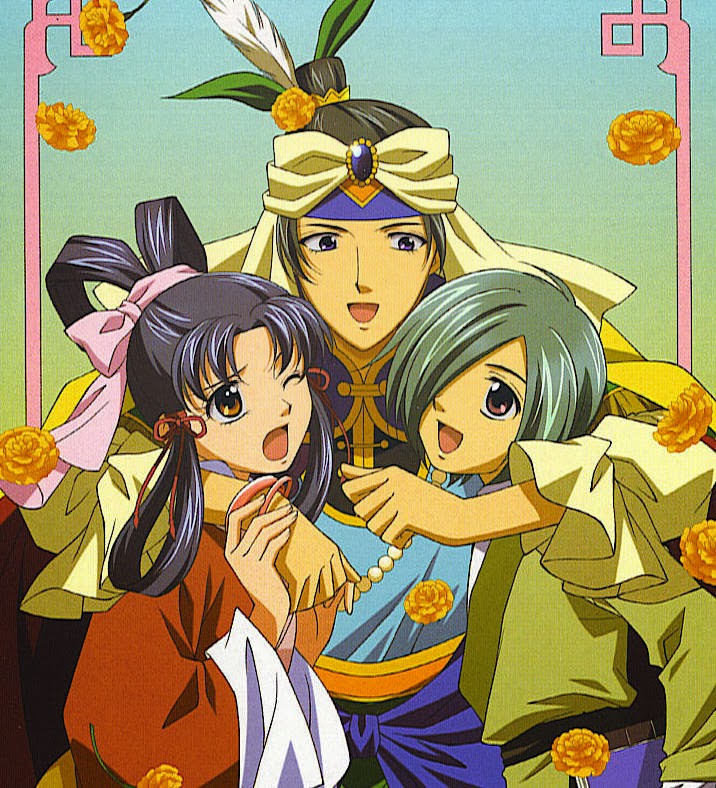
Saiunkoku Monogatori takes place in a fictional Chinese-like land.  The story is based around the life of a young woman named Kou Shuurei.  Shuurei’s family is one of the eight noble families of the land, but they are from an impoverished branch.  Shuurei's mother died when she was young, so Shuurei is very self-sufficient.  She does odd jobs to get by and her father, Shoka, works as a librarian in the imperial court, a role which is very prestigious but pays very poorly.  Shuurei’s dream is to take and pass the imperial exam and become a court official.  Unfortunately, women are forbidden to take the exam or to be court officials.  So Shuurei and her father live relatively hand-to-mouth.  They also live with a young man named Seiran, who was taken in by Shuurei’s father and who acts as Shuurei’s bodyguard.

Shurrei’s life takes a change for the better one day when one of the high court advisers stops by her house and offers her a job.  It seems the new Emperor, Shi Ryuuki, is uninterested in running his country and spends his time flaunting his preference for men instead of working on getting heirs for the throne.  Because Shuurei is known for her intelligence and teaching, and is pretty as well, the Grand Adviser asks Shuurei to enter the imperial household as Ryuuki’s consort for a few months, and to teach Ryuuki how to be Emperor.  In return for this job, the adviser will give Shuurei an unheard of amount of money.  Shuurei accepts the job and her peaceful life changes forever.

Shuurei brings Seiran with her to the palace, meets Ryuuki and begins the job of turning him into Emperor.   She finds that he’s not stupid or lazy, just unwilling to accept the role that's been thrust upon him.  As the youngest of six imperial sons, he was never expected to rule and was treated badly as a child.  He secretly hoped that his exiled older brother, who he loved as the only one who was kind to him as a child, would return and take the throne.  It turns out that Seiran is in fact that brother, but doesn’t want the throne.  Between that and Shuurei’s teachings, Ryuuki turns around and begins to govern.  Shuurei  also gains Ryuuki’s love and admiration. 

As part of the imperial family Shuurei also becomes embroiled in countless and continuous plots and schemes being run by the eight noble houses.  Politics in the imperial court is incredible and convoluted and Shuurei becomes involved in it a lot of it. 

The under-plots run deep in this series and occasionally it’s difficult to remember who is related to whom and whose House is scheming against the Empire or other House.  Besides Shuurei, Seiran, Ryuuki and Shuurei’s father, the other main characters include Ri Kouyou, Vice-Secretary of Civil Administration who is serving Ryuuki directly and who has a penchant for getting lost in the palace, Ran Shuuei, who is a general and exceptional swordsman, and Ro Ensei, who is something of a vagabond, the former governor of Sa province and a person from Seiran’s past.  This group of main characters is joined by a large cast full of relatives and adoptive relatives and various House connections. 

After meeting and working with Shuurei, Ryuuki straightens up and rules his kingdom.  One of the things he does for Shuurei after she leaves the Palace, is make it possible for women to take the imperial exam, allowing her to follow her dream of becoming a court official.  It’s not easy being the first woman to do so.  She ends up retaking the exam orally in front of all the court and advisers because some of them wouldn’t believe she could pass it.  In addition, she barely makes it to her oral exam since other factions plot to keep her away so she can't pass it.  She manages to overcome all of it and become a court official. 

Ryuuki then posts her far away in problematic Sa province as co-governor with Eigetsu, another candidate who passed the exam but who others are also having trouble accepting because of his extreme youth.  Out in the Sa province Eigetsu and Shuurei overcome lots more political intrigue and deal with a different set of politics and characters.

The plot in this series is occasionally hard to follow because of the interconnections between character families, but overall it’s very interesting and the series is worth watching.  It borders on being a reverse-harem anime, with Shuurei surrounded by lots of attractive men, but that aspect is played down.  There is a love triangle undercurrent between Ryuuki, Shuurei and Seiran which runs throughout the series and Shuurei is attracted to a Sa family schemer once she’s in the Sa province, but Saiunkoku Monogatari is not a love story as such. 

This series is actually two season, each 39 episodes long.  Most, if not all, of what I’ve discussed here happens in the first season.   The second season brings more intrigue and different problems for Shuurei-tachi to solve.  I recommend the whole two seasons, but at least watch the first season.  It’s a good series.

Sunday, November 24, 2013

Kyou Kara Maou

Another old series I enjoyed watching was Kyou Kara Maou

This series is a comedy series, which ends up being surprisingly deep.  The story centers around a teenage boy named Shibuya Yuri.  And from the very beginning, it makes fun of many of the stereotypes in anime.  For example, it starts out with the stereotypical, ordinary Japanese schoolgirl who gets pulled into an alternate universe and must go on a quest to save the world.  Oh, Yuri is a pretty ordinary Japanese kid, but he’s a boy for one thing.  Then he’s pulled into the alternate universe by being flushed down the toilet!   The series could also be a harem-type series, with a cast of gorgeous male characters who surround the main female character, except again, Yuri is a boy, and the gorgeous male characters do their best to keep him out of trouble.

The story line goes like this.  On his way home from school one day Yuri interferes when a friend of his is being bullied and the bullies end up flushing him down the toilet and into the alternate world.  The alternate world is a feudal society with two main races of people, humans and demons.  Yuri, it turns out, is this world’s demon-king, or Maou.
 
Much of the early story revolves around Yuri getting used to being Maou and to using the powers he has at his disposal.  He looks different when using his powers in his Maou incarnation, with longer hair and demon eyes.  And during these early episodes his subjects are also getting used to him and his very human biases.  The main characters surrounding Yuri include Conrad (Yuri’s confidant, friend, godfather and chief protector), Wolfram (Yuri’s accidental fiancĂ© and Conrad’s brother), Gwendal (Conrad and Wolfram’s older brother with a fetish for “cute” things), Gunter (Yuri’s teacher in the demon kingdom who has a serious crush on him) and Ken Murata (Yuri’s friend from back home who was being bullied).

Although this series is funny all the way through, it has a much deeper subplot which starts from the very first episode.   The subplot doesn’t become apparent until much further along, but basically, Yuri is a reincarnation of the very first Maou (Shin Ou) who united the demons and many of the humans and formed the current demon kingdom, and in the course of doing that, sealed away a very evil being who is now getting lose in the current age.  Yuri’s soul is one that belonged to a young woman who believed in and trusted the original Maou’s machinations, and who Conrad loved.  Complex story here, but although Yuri springs from the first Maou, he’s very much his own person and does things his way.  His friend Ken Murata turns out to be the first Maou’s best friend, the Holy Seer, who has lived through all these centuries waiting for Yuri to be born and ready, and waiting to help stop the evil being from escaping its confinement.  Murata occasionally finds himself caught between loyalty to the first Maou and to Yuri. 


Along the way as Yuri learns to be demon king, he befriends humans and demons alike and begins to heal centuries of hatred between the two races, building ally countries and gaining friends as he goes.  All his efforts are supported, albeit often unwillingly, by the four faithful at first and later by Murata also.  Kyou Kara Maou is a long series, 117 episodes and 5 OVAs, with plenty of plot twists and “aha” moments when something from a previous episode (sometimes a long time previous) suddenly slots neatly into the overall plot.   It’s a good series, with lots of laughs and strangeness and plenty of plot twists to keep me entertained and watching.  In the US unfortunately I don’t think the entire second season was released on DVD when Geneon quit doing anime.  If you can get hold of the bittorents though, it’s all
worth watching.    

Sunday, November 17, 2013

Terra e

I’m behind getting a post out.  Since new series have essentially just started, I figured I’d go again with an old one.  Today I’m going to talk about Terra e

Terra e, also known as Toward the Terra is a story about telepaths, and an adaption of a manga that came out in 1977.  The story occurs in the far future where humanity is ruled by computers.  Human babies are born from mechanical wombs and given to selected parents to raise until they reach 14 years old.  Then they go through an adulthood exam, which wipes their brain and memories and turns them into functional adults.  In addition, the exam determines if they are latent telepaths, whether they have the Mu factor in their genes.  If they do have the factor, they are culled.  The computers running the human race are rabidly determined to exterminate the Mu telepaths.   The Mu in turn are a race of evolved telepathic humans, who wish nothing more than to rescue all the Mu children and be left alone to live their lives.  They exist on a giant space ship and are constantly searching for the original Terra as a new home.  Terra was rendered uninhabitable by humans before they left it, and the Mu telepaths want to return there and live at peace.
The anime series story centers around the character of Jomy Marcus Shin and covers a lot of years.  In the beginning of the series Jomy is a normal 14 year old boy facing his adulthood exam.  He fails it since he is also a telepath with the Mu factor.  Jomy is rescued from extermination by  the leader of the Mu, a strong telepath named Soldier Blue who is unfortunately approaching the limit of his life and abilities.  Although at first Jomy denies the whole telepathic thing, he eventually takes Blue's place as the leader of the telepaths.

Another main character in the series is Keith Anyan.  Keith is a human raised completely by mechanical means, never having had human parents.  He enters the story when it switches to the military training that young humans undergo to become functional humans who will be involved in the military.  The story here takes place on a space station, and the computer who runs it, “Mother”, favors Keith and is grooming him to be the military leader responsible for wiping out the Mu.  During this phase of the story Keith is responsible for the death of one of my favorite characters in the series, Shiroe.  

As time passes Keith becomes the primary military leader and begins to go after the Mu, even though he knows his aide, Matsuka, is a telepath who uses his powers several times to save Keith’s life.  Keith is not completely bad though, more of an anti-hero.  He also destroys the “mother” computer and station when he finds out he’s a human who has been created, and for the sole purposes of keeping humans in line and killing the Mu. 

Jomy and the telepaths begin to settle a planet they find and attempt to lead normal lives.  They begin to have children by natural childbirth, the first naturally born humans for millennia.  This generation of kids are incredibly powerful telepaths and are led by the first one of them born, Tony.   They also are much more willing to stand and fight rather than run like their parents.  The planet is located by Keith-tachi and the Mu run again.   

Years pass and the Mu find Terra.  In the final battles between Keith and his computer-led forces and the Mu, Jomy and Keith and Blue all die.  But the Mu survive and begin to repopulate Terra.


Obviously once again I've skipped over the majority of the subplots and some of them are important.  I would have liked this series much better if they hadn’t felt the need to kill so many people off, both during it and at the end.  Still, it’s a good series, and worth watching for the story line, the really nice animation style and the excellent music.  I recommend it.  


Sunday, November 3, 2013

Fall Season 2 - 2013

There are several more new series that I’m trying out so I thought I’d talk a little about them also.

Tokyo Ravens is the next series I’m trying out.  A high school boy named Harutora is a member of the prestigious Tsuchimikado onmyoji family.  Unfortunately, he can’t see spirit energy, so he’s hanging out with friends Hokuto and Touji at a backwater onmyoji school.  One day his cousin/childhood friend, Natsume, who also happens to be the current head of the family, comes to visit.  While she’s there, another girl shows up and uses her spirit power to try to raise her dead brother.  Along the way she kills Harutora’s friend Hokuto.  In order to be able to fight spirits, Harutora agrees to be Natsume’s familiar.  Once she seals that deal, Harutora can see and interact with spirits.  They win a battle against the brother-raising bad girl, and then they go to Tokyo to fight.  It looks from what I’ve seen so far that Harutora will be powerful and will come into his own along the way.  So the plot and relationships are probably going to be pretty predictable.  But it’s pretty and has kept me interested so far.

The next one is called Strike the Blood.  I began watching this because I’m attracted to vampire series.  So far the premise here is that a normal high school boy named Akatsuki Kojou has recently become the most powerful vampire in existence (that’s not fully explained at this point).  He is being followed / monitored / protected / attacked by both groups of people and individuals, primarily a middle school Sword Shaman named Himeragi Yukina and a sensei named Minamiya Natsuki, who looks like a grade-school kid.   It looks like Akatsuki will be frighteningly powerful, but that isn’t clear yet.  The conflicted love interests among him and his keepers appear to be fairly standard.  I don’t know if I’ll keep watching this one or not.

Unbreakable Machine Doll is another I’m watching.  I almost dropped this one after the first episode because it’s a little more fan servicey than I like, but the plot so far has become interesting, and I like the animation style.  This series occurs in a universe where machines and magic interact.  Magicians are also called puppeteers, and they magically control “machine dolls” who are essentially human, although they’re not.   Machine dolls have life via a machine/magic hybrid heart which also gives them personalities and feelings.  The hero in this story is Akabane Raishin, who has come from Japan to a prestigious English school for magician training.  His nickname there is Second Last, due to him being ranked 1375th out of 1376 students.  Raishin’s doll is Yaya, a high-powered combat model who also happens to be seriously in love with Raishin.   Raishin has come to this school for revenge, to learn enough to gain access to the ultimate battle where magicians vie for the title of Wiseman -  the strongest magician.  Riashin’s desire to join the battle is not so much to become Wiseman as to find and kill the magician who killed his entire family.  The series is interesting so far, with characters with personalities that are worth following at this point.
  
Arpeggio of Blue Steel (Aoki Hagane no Arpeggio: Ars Nova) is the last one I’m trying out.  The premise in this one is that humans have been driven off the oceans by a mysterious fleet of fog-bound, invincible ships.  One man switches sides to those ships and then mysteriously one invincible submarine ship comes to the humans and is captured by them.  That ship has a human-seeming avatar (little girl, of course, named Iona) who controls it and she is programmed to respond only to the son of the man who switched sides.  The series is about the son, Chihaya Gunzou (high schooler) and his friends sailing the seas in the invincible submarine and using it to help the humans defeat the fog-fleet.  I don’t know whether I’ll watch this one more or not.  It probably depends on whether they just do battle after battle, or they do a more interesting plot and some character development. 


So along with last week’s post, those are the series I’ve picked up this season.  We’ll see how many of them I keep watching to the end.