Saturday, February 23, 2013

X


Today I decided to post about another old series, X, the 2001 TV anime series, not the 1999 movie, which was  . . . not good.    X is done by CLAMP so as you can imagine, the plot is twisty and the characters are in for a lot of tragedy.  It’s sometimes hard to remember that CLAMP did Card Captor Sakura as well as X and Tokyo Babylon.

X is about a young man named Kamui.  Kamui has been gone for a period of time but is returning to the area where he grew up and to the brother and sister who were his best friends as children, Fuuma and Kotori.    Kamui also happens to be destined to either save or destroy the world.

It seems that prophecy has said that Kamui will either lead the group of seven known as the Dragons of Earth, or the group of seven known as the Dragons of Heaven.  Depending on his choice, he will either destroy the present world in order to rebuild it, or save the present world as it is.  The early story line introduces the seven Dragons from each group and details Kamui’s battle to stay clear of all of them and not make a choice.   Unfortunately he cannot not decide and eventually he chooses the Dragons of Earth, to maintain the status quo and save the existing earth.

The bad news is that Kamui’s best friend Fuuma is also his Gemini, his twin (although they look nothing alike).  Fuuma’s destiny is to become the leader of the group Kamui does not choose, and he does so with a vengeance.  He becomes evil personified and kills his own beloved little sister in front of Kamui and then the battles begin between the two groups.  From this point on in the story, Kamui is a wimp and he is beaten at every turn.  His group is decimated and fighting uphill odds because they cannot use the destructive tactics Fuuma’s group uses.

In the end, Kamui gives his life (yes, he dies) to save the existing world and return Fuuma to what he was.  Fuuma returns to being a nice guy, but retains all his memories, so I imagine he has some series issues to work through having killed both his sister and his best friend.
 
Besides this rather straight-forward plot line, CLAMP also adds in a bunch of side-stories about the other characters, including the backstory of one of Kamui’s group, Subaru.  Besides being one of Kamui’s Dragons of Earth, Subaru is the main character from the series Tokyo Babylon.  He is an onmyouji who had a twin sister, Hokuto.  Subaru and Hokuto’s best friend, Seishirou, kills Hokuto in that story, (twisty plot there also) and in this story Seishirou is on the side of the Dragons of Heaven.  So Subaru battles against a man he both hates and loves, but must defeat.  He does defeat Seishirou in X but at a price.


There are several love stories in X between people on opposite sides on the conflict as well as between people on the same side.  I think only one of them ends happily with both characters surviving the series.

X is TRAGIC, with many of the characters from both groups being killed off, and everyone on both sides being touched by tragedy.  It's a story about betrayal, of which there's plenty, and trust, of which there's some.  The series is also pretty, as you would expect from CLAMP.  The music is wonderful and the plot is interesting, if maybe occasionally more complex than necessary.  I liked the series overall but I wasn't thrilled with how it ended, and I spent a couple boxes of Kleenex on it.  So expect tragedy if you decide to watch it.  

Saturday, February 16, 2013

Usagi Drop


I watched this series some time ago and just decided to blog about it.  Usagi Drop is an awesome little series.  It’s one of the super-short, 11 episode series, but it packs a lot into that time frame and for once I think the length is perfect.

Usagi Drop is a slice of life series, a series about everyday life.  The story follows a section of the lives of Kawachi Daikichi and Kaga Rin.  Daikichi is a 30 year old bachelor with a regular life, including a good job and a comfortable routine.  He attends his grandfather’s funeral one day and discovers that his grandfather has an illegitimate child, a 6 year old girl named Rin.  Rin’s mother has abandoned her.  At the funeral Daikichi’s family has also discovered Rin and is freaked out and embarrassed by her presence.  They also have no idea what to do with this little girl.  Daikichi alone seems to see how lost and alone Rin is.  On the spur of the moment, and against the advice of his parents and sister, Daikichi decides to take her in, and the story begins.

The plot is simple and heart-warming.  Daikichi and Rin learn to live with and love each other.  Daikichi goes from being a care-free bachelor, to raising a young girl child.  Watching him deal with every aspect of that is fun.  Simple things like rushing from work to pick Rin up at school, or handling her bed-wetting, or dealing with her illness are all interesting and amusing.  All the little things that make up raising a child actually cause Daikichi to grow up himself.  At first he can't believe her mother would abandon her, so he tracks down Rin’s mother and confronts her.  Diakichi quickly realizes that not only does she not want Rin, but that being with her is not what’s best for Rin.  He eventually comes to realize that he wants to keep Rin with him and raise her, that they belong together and that being a parent has it’s own rewards despite the freedoms lost.

The various scenes that Diakichi and Rin go through are really wonderful, like planting her own tree to grow as she grows, and Daikichi’s family becoming more and more accepting of Rin as she becomes solidly part of Daikichi’s life.  Rin makes a friend at school, a boy named Kouki who happens to be being raised by a single mother, Nitani.  Nitani and Daikichi become friends too along the way and help each other out with both children.  

 If you like slice of life anime you should definitely watch this one. At times it’s almost painfully cute, but also very heart-warming to watch.  The characters are well-developed and Rin is absolutely darling, as well as being her own person.  Although this is not my favorite type of anime, this one was definitely worth watching.  

Sunday, February 10, 2013

Jigoku Shoujo


Again I’m posting about older series while watching new series and waiting to see if I like their endings.  Today I picked Jigoku Shoujo.

Jigoku Shoujo is a series with an interesting premise, and I do so love an interesting premise.  It goes like this:  If you know someone who deserves to go to hell, you can log on to a specific website at the stroke of midnight, and you will be visited immediately by Hell Girl (Jigoku Shoujo).  She will tell you that if you really want that person to go to hell, she will take them.  However there’s a catch, if you send someone to hell, your own soul is forfeit and will go to hell also when you die – be that today or 50 years from now.  So Jigoku Shoujo gives you plenty of time to consider your decision and leaves you with a straw doll with a red string around its neck.  Pull the string off the doll and your wish is fulfilled.  The person goes to hell and you yourself are marked with a mark to remind you that you’ll also be going to hell eventually. 

Interesting premise, right?

The series follows Hell Girl, whose name is Enma Ai, and her three helpers, Hone Onna, Ichimoku Ren and Wanyuudou.  The three helpers keep track of people who are considering wishing someone into hell, as well as helping Ai take the people to hell who are wished there.  The three also become the straw dolls that Ai leaves with people who are trying to make the decision. 

The series begins as individual stories about people who wish other people to hell and how they come to do so. But as the series progresses a deeper plot evolves.  A young girl named Tsugumi begins to “see” Ai and the people who are going to wish others to hell.  When Ai appears and talks to the wisher, Tsugumi has a vision of it.  Tsugumi’s father, Hajime, begins to track Ai-tachi and try to interfere with the process, basically trying to talk people out of wishing others to hell.  Ai and her group don’t appreciate this interference.

Late in the series Ai’s back story comes out.  She was a young girl who was sacrificed by her village because they believed that sacrificing her would allow them to have bountiful crops and prevent them from starving.  She is initially hidden and protected by a boy she cares for, but is eventually found.  She is buried alive by the villagers and the boy, the one person she cared about and thought would protect her, is the last thing she sees as he’s dropping dirt down on her.   In retribution, after death Ai destroys the village and kills everyone in it.  In punishment for that sin, she becomes Hell Girl and for the rest of eternity she is required to take people to hell who are wished there.   

What becomes clear is that Tsugumi and Hajime are the direct descendants of Ai’s non-protector.  He left the village after she was killed and he failed to stop it, and so missed being killed by her.  He built a temple to atone for not being able to protect Ai.  Tsugumi is apparently having visions about Ai because she and Hajime are the boy’s direct descendants.  When Ai realizes that they are, she goes mad and tries to kill Hajime and Tsugumi.  Then she tries to get Tsugumi to send Hajime to hell (which would also doom Tsugumi herself eventually).  Ai’s three helpers try to stop her for fear that her punishment will be even worse if she kills people again.  Ai fails to exact her revenge because Hajime and Tsugumi care too much about each other and Tsugumi resists Ai’s pressures.  In the end, Ai accepts that her friend from before was fallible and goes back to being Hell Girl with her helpers.

Jigoku Shoujo has two more seasons after the first one and the other seasons explore different aspects of the basic plot, like what happens when the people being sent to hell don’t really deserve it.  Ai has no ability to change the decisions people make so must transport people to hell even when they don’t belong.   The other seasons also explore a little back story on the three helpers, and you discover that Ren started existence as a blood-soaked katana, Wanyuudou was a broken wagon wheel and Hone Onna was a prostitute.  Although all three seasons are good, I liked the first season best.  It’s definitely a series worth watching.

Sunday, February 3, 2013

Jormungand


I decide to post about Jormungand now that the second season is over.  The first season didn’t actually ‘end’, leaving everything hanging without even much indication where anything was going to go, so of course I couldn’t post about it.  I like to wait for final endings before deciding if I like a series.

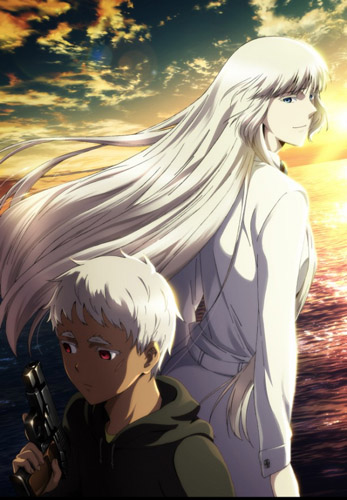
Jormungand follows the exploits of a young woman named Koko Hekmatyar and her merry band of killers.  Koko is an arms dealer - a very smart arms dealer.  Koko got into the arms dealer business by following in the footsteps of her father and her older brother Kasper.  Although not much is said about her father other than hints and innuendos, Kasper is very much a part of the series.  The other main character though is Jonah, a young boy who hates arms dealers and is one of Koko’s trained killer, bodyguards.

Jonah’s family and connections were destroyed by wars made possible by arms dealers, so he despises guns and their dealers.  On the other hand, he has grown up using guns and killing.  He runs afoul of Kasper Hekmatyar, killing one of Kasper’s people while trying to save and protect other children.  Kasper takes him captive and ends up negotiating Jonah’s life and the children’s lives in exchange for Jonah working as a bodyguard for Koko. 

The first series is Koko, Jonah and Koko's merry band traveling around the world and doing arms deals while filling in this background information and the back story on the merry band members.  Also introduced in the first series is Dr. Amanda Minami, aka Dr. Miami, a weird, genius-level researcher with a love of butterflies.  Basically the first series positions all the characters and then ends.

The second series, subtitled Perfect Order, begins where the first series ends and where Koko begins to get serious.  Unknown to everyone, Koko and Dr. Miami are plotting to end all war on the planet.  They are plotting to do this by creating a quantum computer and launching it into space.  With this computer they can control all air traffic and all intelligence satellites, basically controlling the worldwide flow of information.  The second series is a dance - a dance of Koko outwitting and manipulating everyone around her, including people who are trying to rein her in.  Toward the end of the series and the ultimate realization of her plan, Koko announces the plan to her gang and Jonah realizes that setting the plan in motion will cause a significant loss of life.  Jonah jumps ship, literally, and joins Kasper’s group for a couple of years.  In the end though, he returns to Koko and her group and the series ends with Koko ‘pushing the button’ to put her plan into action. 


Jormungand is quirky and brutal at times, but I found the series and the end of the series oddly satisfying. The plot is deep, and the surface jaunting around the world doing arms deals masks the deeper plot for much of the series.  None of the characters are particularly loveable, and Koko can be frighteningly freaky, but overall I enjoyed the series and recommend it. 

Sunday, January 20, 2013

Melody of Oblivion


Another older series, and one that I’ve been re-watching lately, is Melody of Oblivion, and I’m reminded how confused I was by this series when I watched it originally.  I’m also reminded how much I like the music from this series. 

Melody of Oblivion takes place in the future, a future after a massive war has occurred between humans and “monsters” and the monsters have won the war.   Humans are living a relatively normal existence, except for the tribute of children which is paid to the monsters.  These children are food for the monsters, and the tribute is carefully not discussed by anyone in order to maintain the status quo.  The story begins with one young high schooler, Bocca, realizing and objecting to the tribute being paid, and at the same time realizing that he himself is a “Warrior of Melos”. 

Warriors of Melos are humans who can hear the “melody” of the fight against the monsters and can see a young girl who sings it.  Warriors have bonds with special semi-sentient or sentient “Aibar” machines, most of which can take human form.  In addition Warriors have special abilities which allow them to kill the monsters – something your average human cannot do.  Thus the Warriors of Melos continue to battle against the monster’s rule, despite the fact that they are few and far between and the monsters are powerful.    Bocca discovers his own abilities and begins traveling with a girl named Sayoko who is tracking another Warrior of Melos.  Bocca originally joins her to find this warrior to get answers to his own questions.  As they go along, the answers are revealed to him and to the people watching the series, as they run across various scenarios and other Warriors of Melos.   

Along with fighting the monsters directly, the Warriors are up against the Monster Union, a world-spanning group of humans that work directly for the monsters.  Each individual member of the Monster Union runs his or her own territory as directed by the monsters, and tries to destroy the Warriors and their Aibar machines. 

The Warriors of Melos and the Aibar machines begin to collect and work together, trying to get to the Monster King and defeat him and also trying to stop the Monster Union from destroying a space station that’s purpose is to provide the energy that allows the aibar machines to function.  Along the way, Bocca and Sayoko discover they love each other, but Bocca must fight as a Warrior of Melos.  He leaves her to go into space for the final battles, not knowing if he will live to return.  

Bocca and the other Warriors fight off the Monster Union long enough for the space station to be activated, ensuring its survival and the survival of the aibar machines with their abilities. At the time of the final battles, Bocca meets the Monster King, who is himself a former Warrior of Melos.  The Monster King tries to get Bocca to join him, but instead Bocca kills him and returns to Sayoko.  Bocca turns out to be the only Warrior who can return to earth, essentially becoming the last Warrior of Melos.  Bocca and Sayoko live happily ever after, wandering and fighting the monsters and encouraging a new generation of Warriors to carry on the battle.  

And if you think the plot was presented in this nice straight-forward manner, think again.  It was often hard to determine what was happening, what was illusion versus 'real', and how any given scene fit into the grand scheme of things.  Also the series is pretty sexually-oriented.  For example, the Warriors essentially have an orgasm whenever they use their powers to super-charge their arrows, and in scenes late in the series they slather bio-gel on each other's naked bodies before going into space, etc.   Often it seems the sexually-oriented scenes are irritatingly inserted just when you're waiting to find out what's going to happen, or the point of the scene is confusing, like the milking the maids scene.  Still, I liked the story and music enough to buy the DVDs so I consider it worth watching.

Sunday, January 13, 2013

Kamisama Hajimemashita


I’ve been trying to decide what series to blog about, and I think I’ve finally settled on one that I just finished watching, Kamisama Hajimemashita, or also known as Kamisama Kiss.    This is a short, 13 episode series that was developed from the manga.

This story is about a high school girl named Nanami who is left homeless and penniless when her father flees his debts.  While sitting on a park bench with nowhere to go, she comes to the aid of a man trapped in a tree by a small dog.  In gratitude the man invites her to stay at his home and kisses her on the forehead.  The “man” turns out to be a land god named Mikage whose home is a temple/shrine. Unknown to Nanami, when Mikage kisses her on the forehead, he makes her the new land god of his shrine.  Since she has nowhere else to go, Nanami goes the shrine and meets Tomoe, Mikage’s fox demon/familiar, who has been waiting 20 years for Mikage to return.  To say he’s unhappy about Nanami showing up rather than Mikage would be putting it mildly.  Tomoe leaves the shrine, but returns later when Nanami traps him into becoming her familiar in the usual way . . . by kissing him.

The rest of the series introduces other demons and gods and follows Nanami and Tomoe’s dealings with them, as well as the two of them learning to get along with each other.  Despite how short the series is, they manage to have a nicely developed plot line, with Nanami falling in love with Tomoe (of course), and Tomoe refusing to accept a human’s feelings. 

The back story here is that Tomoe once loved a human woman deeply several hundred years ago and did not want to live any more when the woman died.  Mikage took him in and to keep him alive, both made him a familiar and essentially erased his memories and feelings for the human woman.  Unfortunately that caused Tomoe to have a deep dislike of humans in general and to be unwilling to have anything to do with them.  Mikage tried to change this aspect of Tomoe, but with no success.  I get the feeling that the whole Nanami-as-land-god event is created by Mikage as a ploy to break Tomoe of his hatred of humans. 

And of course it works.  Despite lots of ups and down between Nanami and Tomoe, they end up happily together in the end.   So the plot is somewhat deeper than your average boy meets girl, and the characters are all cool, interesting and fun.   Nanami collects other followers along the way, including a crow demon who takes the form of teenage idol named Kurama and a second familiar in the form of a snake demon named Mizuki.   Tomoe’s reactions and interactions with these strays that follow Nanami is often priceless.  Overall I’d say the series was worth watching, and I kind of hope they’ll do a sequel.

Saturday, January 5, 2013

Sword Art Online


I’m going to start the new year talking about Sword Art Online.  I picked this series up late last summer while surfing for something to watch.  I didn’t have high expectations for it, and was delighted to discover that I pretty quickly got hooked and thoroughly enjoyed the series, despite the abrupt change in the middle – or maybe because of it.

The premise of Sword Art Online isn’t new.  It’s about people trapped in a total immersion (“full dive”) online game with an awesome virtual reality (VR) setting.   The story begins with the new online game starting and after 10,000 people log on, they discover themselves unable to log off.  The kick is, the insane creator of the game has rigged it so that if you die in the game, you die for real since your headgear fries your brain in the real world.  The only way out of the game is to win it, and the game itself contains 100 levels, each with a boss monster that must be defeated.  And of course, the bosses get tougher the higher up you go.  The game relies on sword skills and involves no magic.

In that setting are the main characters, a boy with the online name of Kirito and a girl named Asuna.   Kirito was one of the 1000 beta-testers of Sword Art Online (SAO), so he has a bit of an edge, but he is also shunned by other players because of it.  He tends to be a loner, tackling bosses and demons by himself.  He and Asuna meet early on and then part, with Asuna becoming high up in one of the bigger guilds that work the game and clear levels as teams.   Along the way, Kirito and Asuna fall in love and marry each other in the game, living happily together.  They gain friends and helpers, including a small AI named Yui who they consider their child.

In the middle of the series, Kirito wins the game.   He and the remaining survivors have been trapped in the game for more than 2 years, and over 4000 of the original 10,000 have died during that time.  When Kirito wins the game, he and the other survivors are released from the game, except for 300 people who still appear to be in a coma, including Asuna.  Kirito visits her in the hospital daily while trying to recover his life, until friends he made in SAO send him a picture of Asuna taken inside a new game called Alfheim Online.  Kirito once again goes into a full immersion online game, to try to find Asuna and release her.  The new game uses sword skills and magic and the personal avatars of the players are elves.  They have the ability to fly in the game.  Kirito is helped in his quest by an online gamer named Leafa, who happens to be Kirito’s younger step-sister, Suguha, in real life (RL).  Suguha has a huge crush on her brother, but realizes he loves Asuna.   In the online game they are unaware of each other’s real world identities until late in the series.

Alfheim Online is set up in such a way as to be un-winnable, since it’s actually being used by another insane owner to do human experimentation on the 300 remaining SAO players.  The series ends with Kirito once again beating the game, releasing Asuna from being trapped online and being reunited with her in the real world and in the virtual world.  All the gamers live happily ever after, in VR and in RL.

As usual, I’ve left out all the characters but the main ones in discussing the series, so a lot happens that I haven’t mentioned.   Overall I liked this series.   The characters and plot line and setting were good, even though the plot wasn’t all that original.  The music was good, and the idea of being able to fly in the game in the second half of the series would have probably enticed even me into a game like that.  When the series shifted in midstream from one online game to the other I wasn’t sure I liked it, but I did like the happy ever after ending, although the second to the last episode was so dark as to be gruesome.  That could have been toned down a bit.  Even so, I’d say it’s worth watching.