skip to main |
skip to sidebar
It's been a long time since I watched this series so I suppose it's past time that I posted about it.
 Death Note is a unique series in quite a few ways, but the biggest way is this: the main character is the bad guy. This is the only series I've ever watched that that was true, and you'd think with my tendency to like bad guys, that would make this series for me, but it turns out it doesn't. Anyway, Yagami Light doesn't start as as a bad guy. Light is a bored, apathetic honor student who thinks the world is going to hell. One day while gazing out the window of his classroom, he sees a notebook fall past the window. That afternoon he retrieves the notebook, and discovers that it is a Death Note. This black Death Note notebook contains pages of 'rules', the first of which is that if you write a person's name in the Death Note, that person will die.
Light of course thinks it's a practical joke, but when he sees a news story about a kidnapper holding grade school children hostage, he tries it out. He thinks of the guy's face as he's writing his name and the guy drops dead. To ensure it wasn't a fluke, he tries it again on a motorcycle gang member giving a woman a hard time and it works again. Light realizes what he has, and sets himself up to redeem the rotten world by killing all the evil people with the Death Note. He meets the owner of the Death Note, a shinigami named Ryuk, and goes on a killing spree of epic proportions.
And that easily, Light becomes the ultimate bad guy, and gains a nickname around the world of "Kira" (killer).
Death Note is a unique series in quite a few ways, but the biggest way is this: the main character is the bad guy. This is the only series I've ever watched that that was true, and you'd think with my tendency to like bad guys, that would make this series for me, but it turns out it doesn't. Anyway, Yagami Light doesn't start as as a bad guy. Light is a bored, apathetic honor student who thinks the world is going to hell. One day while gazing out the window of his classroom, he sees a notebook fall past the window. That afternoon he retrieves the notebook, and discovers that it is a Death Note. This black Death Note notebook contains pages of 'rules', the first of which is that if you write a person's name in the Death Note, that person will die.
Light of course thinks it's a practical joke, but when he sees a news story about a kidnapper holding grade school children hostage, he tries it out. He thinks of the guy's face as he's writing his name and the guy drops dead. To ensure it wasn't a fluke, he tries it again on a motorcycle gang member giving a woman a hard time and it works again. Light realizes what he has, and sets himself up to redeem the rotten world by killing all the evil people with the Death Note. He meets the owner of the Death Note, a shinigami named Ryuk, and goes on a killing spree of epic proportions.
And that easily, Light becomes the ultimate bad guy, and gains a nickname around the world of "Kira" (killer).
 Another young man, who goes by the name of "L", becomes involved at this point. L is a more-than-genius-level master detective who everyone in the world goes to to solve unsolvable crimes. L is also reclusive and eccentric. He has become aware that criminals in custody are dying, realizes that somehow someone is killing them and goes on the hunt.
The first half of this series is simply awesome. The give and take between Light and L, even before they meet, is outstanding. The swings back and forth as one gets the upper hand and the other fights for his survival are edge-of-your-seat stuff that makes you hungry for more. Light goes to unbelievably complex lengths to outwit L and L goes to incredible lengths to catch him. It's really amazing. Light is nearly brought down by another Death Note user named Misa, but ends up using Misa and her Death Note's shinigami to help his cause.
Another young man, who goes by the name of "L", becomes involved at this point. L is a more-than-genius-level master detective who everyone in the world goes to to solve unsolvable crimes. L is also reclusive and eccentric. He has become aware that criminals in custody are dying, realizes that somehow someone is killing them and goes on the hunt.
The first half of this series is simply awesome. The give and take between Light and L, even before they meet, is outstanding. The swings back and forth as one gets the upper hand and the other fights for his survival are edge-of-your-seat stuff that makes you hungry for more. Light goes to unbelievably complex lengths to outwit L and L goes to incredible lengths to catch him. It's really amazing. Light is nearly brought down by another Death Note user named Misa, but ends up using Misa and her Death Note's shinigami to help his cause.
 Here's another unique thing about the series. It's probably the first one that I wish they had made shorter, rather than wishing it were longer. They could have stopped at 24 episodes instead of going to 37. And the reason for that is this:
Midway through the series, Light wins. He kills L. I was so shocked, and pissed off, that I almost decided not to finish the series. To me the strength of this series was the interactions between Light and L (besides the fact that L was my favorite character - so I guess I should have known he would die!). After L's death, I watched other people, including L's replacements Near and Mello, struggle against Light and watched him manipulate people and it wasn't the same. I think I probably only watched the rest of the series to see Light die in the end.
So did I like the series? I liked the premise, which was unique. I like the characters and the outstanding music. I would like to have changed the plot, which had the moral: even if you're a good guy and you're right, you still die when someone else is stronger. I also learned something about myself. Although I have a tendency to like the bad guys, I only like them when they don't kill off my favorite character. Plus I like the good guys to win in the end, preferably before the body count is too high. I liked the series well enough to buy it on DVD, but I still prefer to watch only the first 2/3rds.
Here's another unique thing about the series. It's probably the first one that I wish they had made shorter, rather than wishing it were longer. They could have stopped at 24 episodes instead of going to 37. And the reason for that is this:
Midway through the series, Light wins. He kills L. I was so shocked, and pissed off, that I almost decided not to finish the series. To me the strength of this series was the interactions between Light and L (besides the fact that L was my favorite character - so I guess I should have known he would die!). After L's death, I watched other people, including L's replacements Near and Mello, struggle against Light and watched him manipulate people and it wasn't the same. I think I probably only watched the rest of the series to see Light die in the end.
So did I like the series? I liked the premise, which was unique. I like the characters and the outstanding music. I would like to have changed the plot, which had the moral: even if you're a good guy and you're right, you still die when someone else is stronger. I also learned something about myself. Although I have a tendency to like the bad guys, I only like them when they don't kill off my favorite character. Plus I like the good guys to win in the end, preferably before the body count is too high. I liked the series well enough to buy it on DVD, but I still prefer to watch only the first 2/3rds.
I've posted about Natsume Yuujinchou before, but that was quite some time ago, after the first series. I just finished watching the fourth season, and I think the series overall is worth another post. This post will cover elements of the entire four seasons.
 Natsume Yuujinchou is a story about a boy named Natsume Takashi. Natsume was born being able to see and interact with youkai, which are supernatural beings or demons. The story takes place when Natsume is in high school and he has inherited a Book of Friends from his grandmother, Natsume Reiko. This book contains the names of hundreds of youkai that Reiko fought during her lifetime. When she beat them, she required them to write their name in her Book of Friends. Natsume now owns this book, and a variety of powerful youkai want to possess it.
One of the youkai wishing to possess the book is a powerful youkai who generally goes around in the shape of an exceedingly fat cat. This is Nyanko-sensei, who is called Madara when is his powerful youkai form. The picture above shows both Nyanko-sensei's forms, Reiko when she was Natsume's age, and Natsume releasing a name from the Book of Friends. Nyanko-sensei decides to be patient since humans are so short-lived, and wait for Natsume's death before taking possession of the book. In the meantime he protects Natsume from harm, both from other powerful youkai and from a few humans also. Ostensibly he does this to protect the book that will come to him, but in reality he probably genuinely cares for Natsume. Natsume goes around returning the name of any youkai who is in the book and asks for its name back. Nyanko-sensei complains about this, but doesn't do anything about it.
Natsume Yuujinchou is a story about a boy named Natsume Takashi. Natsume was born being able to see and interact with youkai, which are supernatural beings or demons. The story takes place when Natsume is in high school and he has inherited a Book of Friends from his grandmother, Natsume Reiko. This book contains the names of hundreds of youkai that Reiko fought during her lifetime. When she beat them, she required them to write their name in her Book of Friends. Natsume now owns this book, and a variety of powerful youkai want to possess it.
One of the youkai wishing to possess the book is a powerful youkai who generally goes around in the shape of an exceedingly fat cat. This is Nyanko-sensei, who is called Madara when is his powerful youkai form. The picture above shows both Nyanko-sensei's forms, Reiko when she was Natsume's age, and Natsume releasing a name from the Book of Friends. Nyanko-sensei decides to be patient since humans are so short-lived, and wait for Natsume's death before taking possession of the book. In the meantime he protects Natsume from harm, both from other powerful youkai and from a few humans also. Ostensibly he does this to protect the book that will come to him, but in reality he probably genuinely cares for Natsume. Natsume goes around returning the name of any youkai who is in the book and asks for its name back. Nyanko-sensei complains about this, but doesn't do anything about it.
 Natsume had a difficult childhood, both because his parents died when he was very young and because he could see and interact with beings that no one else could see. He was thought to be strange and a liar, and was passed around to various relatives until a pair of very distant relatives, Fujiwara Touko and Shigeru, asked to take him. From that time he had a true home, but only slowly during the series does he grow to accept and trust other people. He learns the value of friendship, and that being a friend means allowing his friends to help him and worry about him, instead of protecting them always from what he is. His friends include his best friend Tanuma Kaname, a student in his school who also has some ability to sense youkai. Tanuma is the dark-haired boy wearing the cap in the picture above, which along with Natsume and Nyanko-sensei also includes Natori, tipping his hat, and a small youkai chewing on his.
 Natsume is a very kind person, which tends to get him into lots of trouble. He is kind to people and he is kind to youkai who ask for his help. His kindness to youkai runs him afoul of a powerful clan of exorcists, the Matoba clan, who feel that youkai must be captured and used as tools. If they are too powerful to be captured, they must be sealed away. If they are not powerful enough to be used as tools, they must be destroyed. This philosophy doesn't work for Natsume who has more youkai friends than human friends by the time he runs across the Matoba. Another exorcist, Natori Shuuichi, also has issues with Natsume's tendency to befriend youkai, but Natori is more willing to let Natsume go his own way. Natori ends up being Natsume's friend and taking his side in issues involving youkai, although Natsume also helps Natori when it's necessary to exorcise a bad youkai. Natori and his youkai servant, Hiiragi, are back to back in this picture above and to the left. Two of Natsume's youkai friends are also shown.

Natsume Yuujinchou may end up being one of my all time favorite series. The underlying story about Natsume growing up, getting past his fear of youkai and fear of trust that were instilled in his early years, and learning about friendship is wonderful. The series started out early on as just episodic, with Natsume dealing with various youkai and their problems each episode. Even this wasn't bad, with small mini-arcs occurring and enough tension in the episodes to keep the series from being boring. But the real beauty of the series, other than the character style, which is gorgeous, is the slowly developed underlying story. This last picture shows all Natsume's human friends from school at his house with Fujiwara Touko and Nyanko-sensei and some youkai friends on the roof. The music from the series was so-so, but the rest of the elements of the series made it very worthwhile. I highly recommend it.
I said I'd post about this one when it was finished, so here I am. As usual, I'll be telling the story, so if you haven't seen it and plan to . . . SPOILERS AHEAD.
 Guilty Crown is the story of a boy named Ouma Shu. Shu is a high school student in a Japan that has been devastated by a virus known as the Apocalypse Virus. This virus causes a type of cancer that kills people by turning them into crystal. The virus arrived on a meteor and spread across Japan on a day now called Lost Christmas. From that day, Japan has been ruled under martial law by a multi-national organization called GHQ which keeps Japan quarantined and runs its government. Opposing the multi-national government is a rebellious group variously translated by subbers as Funeral Parlor or Undertakers.
 Shu is as oblivious and apathetic to the world around him as is possible for a teenage boy, spending his time floating through school and mooning over his favorite idol, Yuzuriha Inori. Shu and Inori are in the top picture. Inori uses being an idol as a cover. She is a member of Funeral Parlor and at the start of the series has stolen an item called the Void Genome from the government, with the intention of giving it to the leader of Funeral Parlor, Tsutsugami Gai, shown sitting in the picture to the left. A "void" is a tool that is created from a person's basic personality or heart or substance. The Void Genome allows one to extract the "void" of anyone around and use it for your own purposes. On the run after the theft, fate leads Inori to Shu. Through a series of events that really can only be attributed to fate, Shu ends up with the Void Genome and it's abilities, and he can extract everyone's voids with his right hand.
 Gai, Inori and the gang at Funeral Parlor then spend episodes more or less successfully recruiting Shu into Funeral Parlor, and using him to achieve their ends. At the same time, forces within the government are working to re-activate the Apocalypse Virus and spread it across the whole world to speed the evolution of humans by destroying all existing humans - or something like that. Midway through the series, battles come to a head. During them Shu remembers his past - that his older sister Mana was infected by the meteor virus and was the source of the virus that erupted on Lost Christmas, and that Gai and Shu and Mana had spend time growing up together. He remembers that Mana died on Lost Christmas and Gai left to follow his own destiny. At this point in the story, the battles result in the deaths of Gai and Mana, who had been re-incarnated from the crystals. The remains of Funeral Parlor are scattered and some of them and the students from Shu's school gather at the school. Shu leads them and they attempt to survive the GHQ's drive to eradicate the virus by wiping out everyone left in an area which includes the school. Shu, Inori and some of the students ruthlessly classify and use people's void and Shu discovers that if a void is damaged, it's owner dies.
Because of Shu's ruthlessness, the student's rebel, and at a critical juncture, a re-incarnated Gai reappears, cuts off Shu's right hand and takes his Void Genome power, leaving him for dead. Inori sticks with Shu but is eventually captured by Gai-tachi to be used to re-incarnate Mana again. With Inori taken, Shu regains his will to fight destiny, and through another series of events, gains the last copy of the Void Genome. He reconciles with his friends and goes to recover Inori and stop Gai and the people trying to destroy the world.
Massive battles ensue and Shu arrives where Inori is just after Mana takes over Inori completely. Shu and Gai battle with various voids, and in the end Shu wins and survives, but Gai, Mana and Inori are ultimately lost.
Gai, Inori and the gang at Funeral Parlor then spend episodes more or less successfully recruiting Shu into Funeral Parlor, and using him to achieve their ends. At the same time, forces within the government are working to re-activate the Apocalypse Virus and spread it across the whole world to speed the evolution of humans by destroying all existing humans - or something like that. Midway through the series, battles come to a head. During them Shu remembers his past - that his older sister Mana was infected by the meteor virus and was the source of the virus that erupted on Lost Christmas, and that Gai and Shu and Mana had spend time growing up together. He remembers that Mana died on Lost Christmas and Gai left to follow his own destiny. At this point in the story, the battles result in the deaths of Gai and Mana, who had been re-incarnated from the crystals. The remains of Funeral Parlor are scattered and some of them and the students from Shu's school gather at the school. Shu leads them and they attempt to survive the GHQ's drive to eradicate the virus by wiping out everyone left in an area which includes the school. Shu, Inori and some of the students ruthlessly classify and use people's void and Shu discovers that if a void is damaged, it's owner dies.
Because of Shu's ruthlessness, the student's rebel, and at a critical juncture, a re-incarnated Gai reappears, cuts off Shu's right hand and takes his Void Genome power, leaving him for dead. Inori sticks with Shu but is eventually captured by Gai-tachi to be used to re-incarnate Mana again. With Inori taken, Shu regains his will to fight destiny, and through another series of events, gains the last copy of the Void Genome. He reconciles with his friends and goes to recover Inori and stop Gai and the people trying to destroy the world.
Massive battles ensue and Shu arrives where Inori is just after Mana takes over Inori completely. Shu and Gai battle with various voids, and in the end Shu wins and survives, but Gai, Mana and Inori are ultimately lost.
 As usual, this is pretty much the bare bones of the plot line. In the interest of space I didn't go into any of the interactions between the characters, nor even talk about the lesser characters, including the important members of Funeral Parlor, like Ayase and Tsugumi, the important students, particularly Hare and Yahiro, and Ouma Haruka, Shu's step-mother and a virus researcher. So much of the plot involves these people that it's almost a crime not to include them in the plot line, however this post is already long enough.
Did I like this series? Sort of. The body count was too high. If Inori at least had survived I would have liked it better. If Inori and Gai had survived, I would have liked it a lot better. On the other hand, I would have hated it if Shu had died also, so there's that. The music from the series is really exceptional, especially Inori's songs. The plot is fairly unique, especially the plot devices with the voids and the Void Genome. Wackos trying to destroy the world to allow it to evolve is not that unique, nor is the reluctant hero, but there is enough new here to be interesting. Character styles are good and the animation is good.
Overall I would recommend watching this series. If the body count were lower I would like it better, but I'd say it's worth seeing.
As usual, this is pretty much the bare bones of the plot line. In the interest of space I didn't go into any of the interactions between the characters, nor even talk about the lesser characters, including the important members of Funeral Parlor, like Ayase and Tsugumi, the important students, particularly Hare and Yahiro, and Ouma Haruka, Shu's step-mother and a virus researcher. So much of the plot involves these people that it's almost a crime not to include them in the plot line, however this post is already long enough.
Did I like this series? Sort of. The body count was too high. If Inori at least had survived I would have liked it better. If Inori and Gai had survived, I would have liked it a lot better. On the other hand, I would have hated it if Shu had died also, so there's that. The music from the series is really exceptional, especially Inori's songs. The plot is fairly unique, especially the plot devices with the voids and the Void Genome. Wackos trying to destroy the world to allow it to evolve is not that unique, nor is the reluctant hero, but there is enough new here to be interesting. Character styles are good and the animation is good.
Overall I would recommend watching this series. If the body count were lower I would like it better, but I'd say it's worth seeing.
This morning I was reading a preview of the soon-to-be-released movie, Hunger Games, and the reporter was comparing it's premise to a Japanese movie called Battle Royale. Among his comments he said, "Something about Japanese pop culture makes the sight of a uniformed schoolgirl wielding a bloody sickle seem like the most natural thing in the world." Don't even get me started on the whole skimpily clad girls in battle situations. I'll post about that another time. What caught me this morning was the tendency of the Japanese to kill off their characters. I've talked before in this blog about my feelings about senseless deaths of characters, so today I'll stick to talking about series with high body counts. For the most part I really dislike series that end with most of the cast dead.
 The series that probably takes the prize for this is Gilgamesh. Gilgamesh kills off their entire cats in the last episode. I was so mad I deleted the whole series from my files and have never felt the need to watch it again, like I do most series. Other series with really high body counts that I've never re-watched and never will (although I didn't delete them from my files) include Soukyou no Fafner:Dead Aggressor and Tatakau Shisho:Book of Bantorra. Both of these series end up with few survivors and take out main characters. It's bad enough re-watching series that kill off one or two favorite characters. It's impossible with series that decimate most of the cast along with favorite characters.
There are a few series with high body counts that I can't help liking, even if I wish the body counts were significantly lower. I suppose other aspects of the series attract me enough that I have to get past the body count. At the top of this list would be Wolf's Rain. Wolf's Rain kills off all the main characters in the last 4 episodes. I like the series enough otherwise that I can skip the last four episodes and create my own ending (twist reality a bit. Why not? This blog is Alternate Realities after all.) Another series like this is Shiki. Shiki has a massive body count, but the plot left me so ambivalent about who I considered the good guys vs the bad guys that I ended up liking the series.
 Two older series that I hate the body count in are X and Fushigi Yuugi. Fushigi Yuugi is almost redeemed by keeping the two main characters alive, but since most of the rest of the cast are not living it's hard to like the ending. X even kills the main character. I hate the whole "his death was necessary to redeem the world" premise. That and the whole "you cannot escape your destiny/fate" premise. Those are two plot devices that will immediately cause me to be, shall we say, 'less than happy' with a series.
 Another series I disliked because of the death of the main characters in the end was Chrno Crusade. I hate that the two main characters die and the bad guy lives. If the series creators do that kind of thing to make it more like real life, please stop. I don't watch anime for it to be like real life. Other series with main character deaths at the very end include Katanagatari, Phantom:Requiem and Terra e. These series are why I never decide if I like a series until I've seen the ending. I really dislike the killing of a main character in the last or near to last episode. It usually makes me feel like I've wasted an entire series. There are exceptions of course (Cowboy Bebop), but the series has to be pretty exceptional for me to like it after a main character death in the final episode. I think Cowboy Bebop may be the only one I've ever found.
So that's my take on high body counts. In general I won't like a series that kills too many characters.
Another series I disliked because of the death of the main characters in the end was Chrno Crusade. I hate that the two main characters die and the bad guy lives. If the series creators do that kind of thing to make it more like real life, please stop. I don't watch anime for it to be like real life. Other series with main character deaths at the very end include Katanagatari, Phantom:Requiem and Terra e. These series are why I never decide if I like a series until I've seen the ending. I really dislike the killing of a main character in the last or near to last episode. It usually makes me feel like I've wasted an entire series. There are exceptions of course (Cowboy Bebop), but the series has to be pretty exceptional for me to like it after a main character death in the final episode. I think Cowboy Bebop may be the only one I've ever found.
So that's my take on high body counts. In general I won't like a series that kills too many characters.
I was thinking the other day about the Japanese penchant for using their history as the basis for a fair amount of anime, either as the basis of a series or as the backdrop of one. And of course, high on the list of eras that they focus on is the period of time around the end of the Tokugawa Shogunate and the beginning of the Meiji era. The list of amine which contains the Shinsengumi, or refers to them is pretty long. Interestingly creators of anime series are not at all shy about playing fast and loose with actual historical events and actual historical characters, twisting and changing them to suit plot lines and the need for certain character types. Series involving the Shinsengumi range from nearly purely historical, to romantic, to comedy.
 At the top of the historical list I would have to put PeaceMaker Kurogane. This series follows the exploits of a boy who joins, or tries to join, the Shinsengumi to avenge the death of his parents. The series uses all the main historical figures who were actual members of the Shinsengumi, including Kondou Isami, Hijikata Toushizou, Okita Souji, Saitou Hajime and Yamazaki Susumu, to name some of them. This picture shows the series main character (red hair) standing in front of Okita on the left, Yamazaki on the right and Hijikata in the back. The series adds the main character and other random side figures and the plot revolves around them, but it loosely follows actual events. The plot climaxes at the famous battle between the Shinsengumi and the anti-Tokugawa forces at Ikedaya.
 Another series which is more or less hisorical and follows actual events loosely is Hakuouki: Shinsengumi Kitan. Again actual events are followed and all the historical figures who were real Shinsengumi are present, but in this series the extraneous main character is female and a possible love interest of several in the group. In order to create more plot, a group of demon youkai are included and the Shinsengumi become vampires by drinking a concoction intended to give them strength. The picture shows, from left to right, Okita, Harada Sanosuke, Hijikata and Saitou, with Todou Heisuke in the center. The series was created from a game, which no doubt explains its limitations.
Samurai X is also historical and follows actual events and characters involving the Shinsengumi around the end of the Tokugawa Shogunate. The main character in Samurai X and in the series Rurouni Kenshin is a charcater loosely based on one of the assassins who worked for the anti-Tokugawa forces at the end of the Shogunate. Samurai X mostly follows the hsitoric events and characters, but Rurouni Kenshin is generally only touched by the Shinsengumi peripherally, mostly through the character of Saitou.
One series that is also touched by the Shinsengumi peripherally is Bakumatsu Kikansetsu Irohanihoheto. This is a historical series that occurs in time in the early Meiji period. It doesn't follow Shinsengumi-based events, but two of the people who were part of the Shinsengumi, Hijikata and Okita, make appearances in the series.
Another series which is more or less hisorical and follows actual events loosely is Hakuouki: Shinsengumi Kitan. Again actual events are followed and all the historical figures who were real Shinsengumi are present, but in this series the extraneous main character is female and a possible love interest of several in the group. In order to create more plot, a group of demon youkai are included and the Shinsengumi become vampires by drinking a concoction intended to give them strength. The picture shows, from left to right, Okita, Harada Sanosuke, Hijikata and Saitou, with Todou Heisuke in the center. The series was created from a game, which no doubt explains its limitations.
Samurai X is also historical and follows actual events and characters involving the Shinsengumi around the end of the Tokugawa Shogunate. The main character in Samurai X and in the series Rurouni Kenshin is a charcater loosely based on one of the assassins who worked for the anti-Tokugawa forces at the end of the Shogunate. Samurai X mostly follows the hsitoric events and characters, but Rurouni Kenshin is generally only touched by the Shinsengumi peripherally, mostly through the character of Saitou.
One series that is also touched by the Shinsengumi peripherally is Bakumatsu Kikansetsu Irohanihoheto. This is a historical series that occurs in time in the early Meiji period. It doesn't follow Shinsengumi-based events, but two of the people who were part of the Shinsengumi, Hijikata and Okita, make appearances in the series.
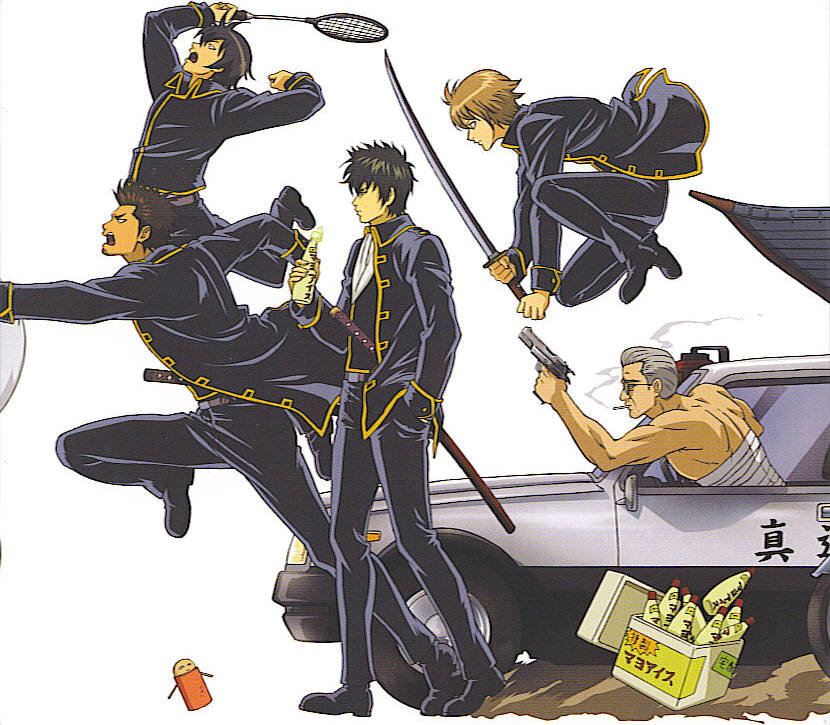
 A series that makes use of all the Shinsengumi characters buts twists them almost beyond recognition is Gintama. Gintama is a unique series that falls into the category of 'historical science fiction'. It takes place in fuedal Japan, but a fuedal Japan that has been taken over by aliens. The Shinsengumi are acting as a police force for the alien conquerers and the people in power. The four Shinsengumi pictured here include Yamazaki (badminton racket), Kondou (running), Hijikata (with mayonaise) and Okita (katana). The series is a comedy of course, and it's main character, Sakata Gintoki, is frequently at odds with the Shinsengumi characters. Nothing here follows real historical events of course.
So there you have it. There are other historical periods and figures that anime creators like to play with, but the Shinsengumi is apparently one of their favorites. I suspect I'll see them again in other anime.
A series that makes use of all the Shinsengumi characters buts twists them almost beyond recognition is Gintama. Gintama is a unique series that falls into the category of 'historical science fiction'. It takes place in fuedal Japan, but a fuedal Japan that has been taken over by aliens. The Shinsengumi are acting as a police force for the alien conquerers and the people in power. The four Shinsengumi pictured here include Yamazaki (badminton racket), Kondou (running), Hijikata (with mayonaise) and Okita (katana). The series is a comedy of course, and it's main character, Sakata Gintoki, is frequently at odds with the Shinsengumi characters. Nothing here follows real historical events of course.
So there you have it. There are other historical periods and figures that anime creators like to play with, but the Shinsengumi is apparently one of their favorites. I suspect I'll see them again in other anime.
I did say that one of these days I'd go back and figure out where the filler arcs are and post them. You know, just in case someone might want to follow the main story line only. So this post gives a synopsis of where the filler arcs are. Of course, I didn't go back and figure out where every random Don Kan'nonji - Karaku-raizer episode is, so you may run across those, but this post gives the episodes which contains main plot line, and the general position and content of the main filler arcs. Here goes:
 Episodes 1 - 63: Main story line - This is the start of the Aizen arc, through the rescue of Rukia, the uncovering of Aizen's scheming and the departure of Aizen-tachi from Soul Society.
Episodes 64 - 109: Filler Arc - This is the Bounto arc. Yes, 45 painful episodes of the Bounto arc. If you're going to skip any of Bleach at all this arc has my vote. Like most filler arcs this one introduces characters who show up later in random episodes and fillers, but not in the main story line since they don't exist in the manga. This arc introduces three mod-souls who show up often in subsequent filler arcs.
Episodes 110 - 142: Main story line - This section covers Ichigo's interactions and training with the Visored, various other character's training efforts, and various Soul Society members helping out in Karakura town. I split this from the next section which is also main story line because the next section is where the gang actually enters Hueca Mundo and to my mind begins the Hueca Mundo arc.
Episodes 1 - 63: Main story line - This is the start of the Aizen arc, through the rescue of Rukia, the uncovering of Aizen's scheming and the departure of Aizen-tachi from Soul Society.
Episodes 64 - 109: Filler Arc - This is the Bounto arc. Yes, 45 painful episodes of the Bounto arc. If you're going to skip any of Bleach at all this arc has my vote. Like most filler arcs this one introduces characters who show up later in random episodes and fillers, but not in the main story line since they don't exist in the manga. This arc introduces three mod-souls who show up often in subsequent filler arcs.
Episodes 110 - 142: Main story line - This section covers Ichigo's interactions and training with the Visored, various other character's training efforts, and various Soul Society members helping out in Karakura town. I split this from the next section which is also main story line because the next section is where the gang actually enters Hueca Mundo and to my mind begins the Hueca Mundo arc.
 Episodes 142 - 167: Main story line - This section covers Ichigo-tachi entering Hueca Mundo to save Inoue Orihime who has been captured by Aizen-tachi. The early interactions of the group in Hueca Mundo are in here. Also in this section is a short arc between Rukia and a lone shinigami who is there fighting Hollows. I'm pretty sure that arc isn't in the manga, which makes it a filler arc, but it's short.
Episodes 168 - 189: Filler Arc - This is the Captain Amagai arc. This arc is not as painful as the Bounto arc was, but also not especially exciting. It introduces Rurichia-sama, who comes back in other fillers.
Episodes 190 - 203: Main story line - This is a short taste ofwhat's going on in the main story line in Hueca Mundo.
Episodes 142 - 167: Main story line - This section covers Ichigo-tachi entering Hueca Mundo to save Inoue Orihime who has been captured by Aizen-tachi. The early interactions of the group in Hueca Mundo are in here. Also in this section is a short arc between Rukia and a lone shinigami who is there fighting Hollows. I'm pretty sure that arc isn't in the manga, which makes it a filler arc, but it's short.
Episodes 168 - 189: Filler Arc - This is the Captain Amagai arc. This arc is not as painful as the Bounto arc was, but also not especially exciting. It introduces Rurichia-sama, who comes back in other fillers.
Episodes 190 - 203: Main story line - This is a short taste ofwhat's going on in the main story line in Hueca Mundo.
 Episodes 204 - 205: Filler arc - sort of. A two episode Rurichia story before the main story line goes to the past.
Episode 206 - 212: Main story line: This way-too-short, 6-episode section gives the background of Aizen, Urahara and the Visored and explains where everything began.
Episodes 213 - 214: Filler - or rather two random episodes
Episodes 215 - 226: Main story line - The main story line was struggling to stay behind the manga at this point, as you can tell from short random episodes and short bursts of main story line.
Episodes 227 - 229: Filler - three more random episodes
Episodes 230 - 255: Filler arc - This is the Muramasa arc, and it's far and away the best filler arc in the series. I recommend you do not skip this arc, as it introduces a whole slew of new cool characters to a series which already has an amazing amount of cool characters.
Episodes 204 - 205: Filler arc - sort of. A two episode Rurichia story before the main story line goes to the past.
Episode 206 - 212: Main story line: This way-too-short, 6-episode section gives the background of Aizen, Urahara and the Visored and explains where everything began.
Episodes 213 - 214: Filler - or rather two random episodes
Episodes 215 - 226: Main story line - The main story line was struggling to stay behind the manga at this point, as you can tell from short random episodes and short bursts of main story line.
Episodes 227 - 229: Filler - three more random episodes
Episodes 230 - 255: Filler arc - This is the Muramasa arc, and it's far and away the best filler arc in the series. I recommend you do not skip this arc, as it introduces a whole slew of new cool characters to a series which already has an amazing amount of cool characters.
 Episodes 256 - 265: Filler - Random zanpakuto stories - spin off fillers from the Muramasa arc.
Episodes 266 - 310: Main story line - end of the Aizen arc. Nothing else to say about that. Or rather I've said it before.
Episodes 311 - 316: Filler - random episodes
Episodes 317 - 341: Filler arc - This is the Nozomi, or Reigai takeover of Soul Society arc. As filler arcs go, this one isn't too bad, but because Ichigo is losing all his reiatsu, he's not as effectual as you'd like him to be.
Episodes 342 - current: Main story line - This is the new post-Aizen story line and it begins with a fairly painful (as in emotional, tear-jerker, not as in Bounto-painful-to-watch) couple of episodes as Ichigo and Rukia say goodbye. After he loses his reiatsu he can no longer see her or any other spirits. I'll do a separate post later on the new story line.
So that's it. I may be an episode or two off in a couple of places, but this is generally how the series runs. Of the current 360 episodes, about 212 of them are main story line. Or another way of looking at it would be that there's a pretty impressive roughly 150 episodes of filler story. The only fillers I would not watch if I were doing it again would be the Bounto arc and any and all Don Kan'nonji - Karaku-raizer episodes. The rest are probably worth watching. If you just want the main story though, you now know where it is.
Episodes 256 - 265: Filler - Random zanpakuto stories - spin off fillers from the Muramasa arc.
Episodes 266 - 310: Main story line - end of the Aizen arc. Nothing else to say about that. Or rather I've said it before.
Episodes 311 - 316: Filler - random episodes
Episodes 317 - 341: Filler arc - This is the Nozomi, or Reigai takeover of Soul Society arc. As filler arcs go, this one isn't too bad, but because Ichigo is losing all his reiatsu, he's not as effectual as you'd like him to be.
Episodes 342 - current: Main story line - This is the new post-Aizen story line and it begins with a fairly painful (as in emotional, tear-jerker, not as in Bounto-painful-to-watch) couple of episodes as Ichigo and Rukia say goodbye. After he loses his reiatsu he can no longer see her or any other spirits. I'll do a separate post later on the new story line.
So that's it. I may be an episode or two off in a couple of places, but this is generally how the series runs. Of the current 360 episodes, about 212 of them are main story line. Or another way of looking at it would be that there's a pretty impressive roughly 150 episodes of filler story. The only fillers I would not watch if I were doing it again would be the Bounto arc and any and all Don Kan'nonji - Karaku-raizer episodes. The rest are probably worth watching. If you just want the main story though, you now know where it is.
I've been thinking that I need to write a post about the series Fruits Basket, so here I go. This series was one of the earliest series I watched when I first began watching fan-subbed anime. It's still high up on my list of all time favorite series.
Fruits Basket is what I call an "everyday" series. Modern day, everyday, normal life - with something of a twist in this particular case. The story follows three high school kids through a short period in their lives. The main characters are a girl named Honda Tohru, and two boys who are cousins, Souma Yuki and Souma Kyou. The picture shows these three and the boy's older cousin Shigure, to the far left. Yuki and Kyou are in school uniforms, Yuki with gray hair and Kyou with orange.
 Tohru is a girl who is always smiling and always positive, despite the fact that her father died when she was a toddler, and she had lost her mother in an accident shortly before the story begins. After her mother's death Tohru lived with her grandfather until his house began undergoing renovations. Then, instead of being a bother to her friends, Tohru pitches a tent to live in. She happens to pitch her tent on the property of the Souma family.
Souma Yuki is in Tohru's class at school and he is living with Shigure in a house near where Tohru is living in her tent. When Yuki and Shigure discover Tohru in her tent and her tent is destroyed by a storm, they invite her to live with them free of charge in exchange for cooking and housework. She agrees.
And that's the basic story line except for one pretty major detail. The Souma family is under a curse. The curse of the Juunishi affects 14 members of the extended Souma family who are born with the curse. 12 are cursed by each of the 12 animals of the Zodiac (thus Juunishi), one is cursed by the cat, which is not a member of the zodiac, and one bears the brunt of the curse and is thus the head of the family. This particular Souma, Akito, does not have an animal form but he will die young due to the curse. For the most part these cursed Souma's live pretty normal human lives, however, sickness, embarrassment, or bumping into a member of the opposite sex, will cause them to transform into their animal form.
Tohru is a girl who is always smiling and always positive, despite the fact that her father died when she was a toddler, and she had lost her mother in an accident shortly before the story begins. After her mother's death Tohru lived with her grandfather until his house began undergoing renovations. Then, instead of being a bother to her friends, Tohru pitches a tent to live in. She happens to pitch her tent on the property of the Souma family.
Souma Yuki is in Tohru's class at school and he is living with Shigure in a house near where Tohru is living in her tent. When Yuki and Shigure discover Tohru in her tent and her tent is destroyed by a storm, they invite her to live with them free of charge in exchange for cooking and housework. She agrees.
And that's the basic story line except for one pretty major detail. The Souma family is under a curse. The curse of the Juunishi affects 14 members of the extended Souma family who are born with the curse. 12 are cursed by each of the 12 animals of the Zodiac (thus Juunishi), one is cursed by the cat, which is not a member of the zodiac, and one bears the brunt of the curse and is thus the head of the family. This particular Souma, Akito, does not have an animal form but he will die young due to the curse. For the most part these cursed Souma's live pretty normal human lives, however, sickness, embarrassment, or bumping into a member of the opposite sex, will cause them to transform into their animal form.
 When Shigure (dog) and Yuki (rat) take Tohru in, they vow to be careful around her, but Kyou (cat) shows up, and through his carelessness Tohru discovers the Souma's most important secret. In this picture Shigure, Kyou and Yuki have become the dog, cat and rat after accidentally bumping into Tohru, and she's pretty freaked out by that at first. Luckily one of the Juunishi can erase portions of people's memories in order to keep the secret, however in doing so, Tohru will lose all memory of the Souma's. Yuki doesn't want Tohru to forget him and Tohru doesn't want to forget any of them. Akito, as head of the family, decides to allow Tohru to keep her memory and to stay with Yuki, Kyou and Shigure, assuming that she will be driven off by the nature of the curse. However Tohru's personality lets her always accept others for who they are and she stays.
This story line is wonderful, and often very fun, as Tohru meets various members of the Juunishi and helps many of them come to terms with their own issues. Tohru changes each person she comes into contact with, often helping them by just accepting them and being her happy, occasionally oblivious self. The story is about growing past hardship, staying true to yourself and your friends, accepting other's frailties and seeing past them. There are a multitude of lessons to take away from this series, and all of it's incredibly well done. There's humor and sadness and triumph and loss. You end up feeling good about the series. In the end, Tohru even takes on the bitter Akito who goes out of his way to hurt others because he hates his own life so much.
Along with the excellent plot line, the series also has very good music and a great character style. The story is a non-ending ending, with life going on for Tohru and the Souma's, but you're actually happy to see that. If you haven't ever seen this series, I highly recommend it. Maybe I'll watch it again.
And if you're wondering where the name Fruits Basket comes from, it's explained in the series.
When Shigure (dog) and Yuki (rat) take Tohru in, they vow to be careful around her, but Kyou (cat) shows up, and through his carelessness Tohru discovers the Souma's most important secret. In this picture Shigure, Kyou and Yuki have become the dog, cat and rat after accidentally bumping into Tohru, and she's pretty freaked out by that at first. Luckily one of the Juunishi can erase portions of people's memories in order to keep the secret, however in doing so, Tohru will lose all memory of the Souma's. Yuki doesn't want Tohru to forget him and Tohru doesn't want to forget any of them. Akito, as head of the family, decides to allow Tohru to keep her memory and to stay with Yuki, Kyou and Shigure, assuming that she will be driven off by the nature of the curse. However Tohru's personality lets her always accept others for who they are and she stays.
This story line is wonderful, and often very fun, as Tohru meets various members of the Juunishi and helps many of them come to terms with their own issues. Tohru changes each person she comes into contact with, often helping them by just accepting them and being her happy, occasionally oblivious self. The story is about growing past hardship, staying true to yourself and your friends, accepting other's frailties and seeing past them. There are a multitude of lessons to take away from this series, and all of it's incredibly well done. There's humor and sadness and triumph and loss. You end up feeling good about the series. In the end, Tohru even takes on the bitter Akito who goes out of his way to hurt others because he hates his own life so much.
Along with the excellent plot line, the series also has very good music and a great character style. The story is a non-ending ending, with life going on for Tohru and the Souma's, but you're actually happy to see that. If you haven't ever seen this series, I highly recommend it. Maybe I'll watch it again.
And if you're wondering where the name Fruits Basket comes from, it's explained in the series.
 Death Note is a unique series in quite a few ways, but the biggest way is this: the main character is the bad guy. This is the only series I've ever watched that that was true, and you'd think with my tendency to like bad guys, that would make this series for me, but it turns out it doesn't. Anyway, Yagami Light doesn't start as as a bad guy. Light is a bored, apathetic honor student who thinks the world is going to hell. One day while gazing out the window of his classroom, he sees a notebook fall past the window. That afternoon he retrieves the notebook, and discovers that it is a Death Note. This black Death Note notebook contains pages of 'rules', the first of which is that if you write a person's name in the Death Note, that person will die.
  Another young man, who goes by the name of "L", becomes involved at this point. L is a more-than-genius-level master detective who everyone in the world goes to to solve unsolvable crimes. L is also reclusive and eccentric. He has become aware that criminals in custody are dying, realizes that somehow someone is killing them and goes on the hunt.
 Here's another unique thing about the series. It's probably the first one that I wish they had made shorter, rather than wishing it were longer. They could have stopped at 24 episodes instead of going to 37. And the reason for that is this: