skip to main |
skip to sidebar
I was thinking the other day about the Japanese penchant for using their history as the basis for a fair amount of anime, either as the basis of a series or as the backdrop of one. And of course, high on the list of eras that they focus on is the period of time around the end of the Tokugawa Shogunate and the beginning of the Meiji era. The list of amine which contains the Shinsengumi, or refers to them is pretty long. Interestingly creators of anime series are not at all shy about playing fast and loose with actual historical events and actual historical characters, twisting and changing them to suit plot lines and the need for certain character types. Series involving the Shinsengumi range from nearly purely historical, to romantic, to comedy.
 At the top of the historical list I would have to put PeaceMaker Kurogane. This series follows the exploits of a boy who joins, or tries to join, the Shinsengumi to avenge the death of his parents. The series uses all the main historical figures who were actual members of the Shinsengumi, including Kondou Isami, Hijikata Toushizou, Okita Souji, Saitou Hajime and Yamazaki Susumu, to name some of them. This picture shows the series main character (red hair) standing in front of Okita on the left, Yamazaki on the right and Hijikata in the back. The series adds the main character and other random side figures and the plot revolves around them, but it loosely follows actual events. The plot climaxes at the famous battle between the Shinsengumi and the anti-Tokugawa forces at Ikedaya.
 Another series which is more or less hisorical and follows actual events loosely is Hakuouki: Shinsengumi Kitan. Again actual events are followed and all the historical figures who were real Shinsengumi are present, but in this series the extraneous main character is female and a possible love interest of several in the group. In order to create more plot, a group of demon youkai are included and the Shinsengumi become vampires by drinking a concoction intended to give them strength. The picture shows, from left to right, Okita, Harada Sanosuke, Hijikata and Saitou, with Todou Heisuke in the center. The series was created from a game, which no doubt explains its limitations.
Samurai X is also historical and follows actual events and characters involving the Shinsengumi around the end of the Tokugawa Shogunate. The main character in Samurai X and in the series Rurouni Kenshin is a charcater loosely based on one of the assassins who worked for the anti-Tokugawa forces at the end of the Shogunate. Samurai X mostly follows the hsitoric events and characters, but Rurouni Kenshin is generally only touched by the Shinsengumi peripherally, mostly through the character of Saitou.
One series that is also touched by the Shinsengumi peripherally is Bakumatsu Kikansetsu Irohanihoheto. This is a historical series that occurs in time in the early Meiji period. It doesn't follow Shinsengumi-based events, but two of the people who were part of the Shinsengumi, Hijikata and Okita, make appearances in the series.
Another series which is more or less hisorical and follows actual events loosely is Hakuouki: Shinsengumi Kitan. Again actual events are followed and all the historical figures who were real Shinsengumi are present, but in this series the extraneous main character is female and a possible love interest of several in the group. In order to create more plot, a group of demon youkai are included and the Shinsengumi become vampires by drinking a concoction intended to give them strength. The picture shows, from left to right, Okita, Harada Sanosuke, Hijikata and Saitou, with Todou Heisuke in the center. The series was created from a game, which no doubt explains its limitations.
Samurai X is also historical and follows actual events and characters involving the Shinsengumi around the end of the Tokugawa Shogunate. The main character in Samurai X and in the series Rurouni Kenshin is a charcater loosely based on one of the assassins who worked for the anti-Tokugawa forces at the end of the Shogunate. Samurai X mostly follows the hsitoric events and characters, but Rurouni Kenshin is generally only touched by the Shinsengumi peripherally, mostly through the character of Saitou.
One series that is also touched by the Shinsengumi peripherally is Bakumatsu Kikansetsu Irohanihoheto. This is a historical series that occurs in time in the early Meiji period. It doesn't follow Shinsengumi-based events, but two of the people who were part of the Shinsengumi, Hijikata and Okita, make appearances in the series.
 A series that makes use of all the Shinsengumi characters buts twists them almost beyond recognition is Gintama. Gintama is a unique series that falls into the category of 'historical science fiction'. It takes place in fuedal Japan, but a fuedal Japan that has been taken over by aliens. The Shinsengumi are acting as a police force for the alien conquerers and the people in power. The four Shinsengumi pictured here include Yamazaki (badminton racket), Kondou (running), Hijikata (with mayonaise) and Okita (katana). The series is a comedy of course, and it's main character, Sakata Gintoki, is frequently at odds with the Shinsengumi characters. Nothing here follows real historical events of course.
So there you have it. There are other historical periods and figures that anime creators like to play with, but the Shinsengumi is apparently one of their favorites. I suspect I'll see them again in other anime.
A series that makes use of all the Shinsengumi characters buts twists them almost beyond recognition is Gintama. Gintama is a unique series that falls into the category of 'historical science fiction'. It takes place in fuedal Japan, but a fuedal Japan that has been taken over by aliens. The Shinsengumi are acting as a police force for the alien conquerers and the people in power. The four Shinsengumi pictured here include Yamazaki (badminton racket), Kondou (running), Hijikata (with mayonaise) and Okita (katana). The series is a comedy of course, and it's main character, Sakata Gintoki, is frequently at odds with the Shinsengumi characters. Nothing here follows real historical events of course.
So there you have it. There are other historical periods and figures that anime creators like to play with, but the Shinsengumi is apparently one of their favorites. I suspect I'll see them again in other anime.
I did say that one of these days I'd go back and figure out where the filler arcs are and post them. You know, just in case someone might want to follow the main story line only. So this post gives a synopsis of where the filler arcs are. Of course, I didn't go back and figure out where every random Don Kan'nonji - Karaku-raizer episode is, so you may run across those, but this post gives the episodes which contains main plot line, and the general position and content of the main filler arcs. Here goes:
 Episodes 1 - 63: Main story line - This is the start of the Aizen arc, through the rescue of Rukia, the uncovering of Aizen's scheming and the departure of Aizen-tachi from Soul Society.
Episodes 64 - 109: Filler Arc - This is the Bounto arc. Yes, 45 painful episodes of the Bounto arc. If you're going to skip any of Bleach at all this arc has my vote. Like most filler arcs this one introduces characters who show up later in random episodes and fillers, but not in the main story line since they don't exist in the manga. This arc introduces three mod-souls who show up often in subsequent filler arcs.
Episodes 110 - 142: Main story line - This section covers Ichigo's interactions and training with the Visored, various other character's training efforts, and various Soul Society members helping out in Karakura town. I split this from the next section which is also main story line because the next section is where the gang actually enters Hueca Mundo and to my mind begins the Hueca Mundo arc.
Episodes 1 - 63: Main story line - This is the start of the Aizen arc, through the rescue of Rukia, the uncovering of Aizen's scheming and the departure of Aizen-tachi from Soul Society.
Episodes 64 - 109: Filler Arc - This is the Bounto arc. Yes, 45 painful episodes of the Bounto arc. If you're going to skip any of Bleach at all this arc has my vote. Like most filler arcs this one introduces characters who show up later in random episodes and fillers, but not in the main story line since they don't exist in the manga. This arc introduces three mod-souls who show up often in subsequent filler arcs.
Episodes 110 - 142: Main story line - This section covers Ichigo's interactions and training with the Visored, various other character's training efforts, and various Soul Society members helping out in Karakura town. I split this from the next section which is also main story line because the next section is where the gang actually enters Hueca Mundo and to my mind begins the Hueca Mundo arc.
 Episodes 142 - 167: Main story line - This section covers Ichigo-tachi entering Hueca Mundo to save Inoue Orihime who has been captured by Aizen-tachi. The early interactions of the group in Hueca Mundo are in here. Also in this section is a short arc between Rukia and a lone shinigami who is there fighting Hollows. I'm pretty sure that arc isn't in the manga, which makes it a filler arc, but it's short.
Episodes 168 - 189: Filler Arc - This is the Captain Amagai arc. This arc is not as painful as the Bounto arc was, but also not especially exciting. It introduces Rurichia-sama, who comes back in other fillers.
Episodes 190 - 203: Main story line - This is a short taste ofwhat's going on in the main story line in Hueca Mundo.
Episodes 142 - 167: Main story line - This section covers Ichigo-tachi entering Hueca Mundo to save Inoue Orihime who has been captured by Aizen-tachi. The early interactions of the group in Hueca Mundo are in here. Also in this section is a short arc between Rukia and a lone shinigami who is there fighting Hollows. I'm pretty sure that arc isn't in the manga, which makes it a filler arc, but it's short.
Episodes 168 - 189: Filler Arc - This is the Captain Amagai arc. This arc is not as painful as the Bounto arc was, but also not especially exciting. It introduces Rurichia-sama, who comes back in other fillers.
Episodes 190 - 203: Main story line - This is a short taste ofwhat's going on in the main story line in Hueca Mundo.
 Episodes 204 - 205: Filler arc - sort of. A two episode Rurichia story before the main story line goes to the past.
Episode 206 - 212: Main story line: This way-too-short, 6-episode section gives the background of Aizen, Urahara and the Visored and explains where everything began.
Episodes 213 - 214: Filler - or rather two random episodes
Episodes 215 - 226: Main story line - The main story line was struggling to stay behind the manga at this point, as you can tell from short random episodes and short bursts of main story line.
Episodes 227 - 229: Filler - three more random episodes
Episodes 230 - 255: Filler arc - This is the Muramasa arc, and it's far and away the best filler arc in the series. I recommend you do not skip this arc, as it introduces a whole slew of new cool characters to a series which already has an amazing amount of cool characters.
Episodes 204 - 205: Filler arc - sort of. A two episode Rurichia story before the main story line goes to the past.
Episode 206 - 212: Main story line: This way-too-short, 6-episode section gives the background of Aizen, Urahara and the Visored and explains where everything began.
Episodes 213 - 214: Filler - or rather two random episodes
Episodes 215 - 226: Main story line - The main story line was struggling to stay behind the manga at this point, as you can tell from short random episodes and short bursts of main story line.
Episodes 227 - 229: Filler - three more random episodes
Episodes 230 - 255: Filler arc - This is the Muramasa arc, and it's far and away the best filler arc in the series. I recommend you do not skip this arc, as it introduces a whole slew of new cool characters to a series which already has an amazing amount of cool characters.
 Episodes 256 - 265: Filler - Random zanpakuto stories - spin off fillers from the Muramasa arc.
Episodes 266 - 310: Main story line - end of the Aizen arc. Nothing else to say about that. Or rather I've said it before.
Episodes 311 - 316: Filler - random episodes
Episodes 317 - 341: Filler arc - This is the Nozomi, or Reigai takeover of Soul Society arc. As filler arcs go, this one isn't too bad, but because Ichigo is losing all his reiatsu, he's not as effectual as you'd like him to be.
Episodes 342 - current: Main story line - This is the new post-Aizen story line and it begins with a fairly painful (as in emotional, tear-jerker, not as in Bounto-painful-to-watch) couple of episodes as Ichigo and Rukia say goodbye. After he loses his reiatsu he can no longer see her or any other spirits. I'll do a separate post later on the new story line.
So that's it. I may be an episode or two off in a couple of places, but this is generally how the series runs. Of the current 360 episodes, about 212 of them are main story line. Or another way of looking at it would be that there's a pretty impressive roughly 150 episodes of filler story. The only fillers I would not watch if I were doing it again would be the Bounto arc and any and all Don Kan'nonji - Karaku-raizer episodes. The rest are probably worth watching. If you just want the main story though, you now know where it is.
Episodes 256 - 265: Filler - Random zanpakuto stories - spin off fillers from the Muramasa arc.
Episodes 266 - 310: Main story line - end of the Aizen arc. Nothing else to say about that. Or rather I've said it before.
Episodes 311 - 316: Filler - random episodes
Episodes 317 - 341: Filler arc - This is the Nozomi, or Reigai takeover of Soul Society arc. As filler arcs go, this one isn't too bad, but because Ichigo is losing all his reiatsu, he's not as effectual as you'd like him to be.
Episodes 342 - current: Main story line - This is the new post-Aizen story line and it begins with a fairly painful (as in emotional, tear-jerker, not as in Bounto-painful-to-watch) couple of episodes as Ichigo and Rukia say goodbye. After he loses his reiatsu he can no longer see her or any other spirits. I'll do a separate post later on the new story line.
So that's it. I may be an episode or two off in a couple of places, but this is generally how the series runs. Of the current 360 episodes, about 212 of them are main story line. Or another way of looking at it would be that there's a pretty impressive roughly 150 episodes of filler story. The only fillers I would not watch if I were doing it again would be the Bounto arc and any and all Don Kan'nonji - Karaku-raizer episodes. The rest are probably worth watching. If you just want the main story though, you now know where it is.
I've been thinking that I need to write a post about the series Fruits Basket, so here I go. This series was one of the earliest series I watched when I first began watching fan-subbed anime. It's still high up on my list of all time favorite series.
Fruits Basket is what I call an "everyday" series. Modern day, everyday, normal life - with something of a twist in this particular case. The story follows three high school kids through a short period in their lives. The main characters are a girl named Honda Tohru, and two boys who are cousins, Souma Yuki and Souma Kyou. The picture shows these three and the boy's older cousin Shigure, to the far left. Yuki and Kyou are in school uniforms, Yuki with gray hair and Kyou with orange.
 Tohru is a girl who is always smiling and always positive, despite the fact that her father died when she was a toddler, and she had lost her mother in an accident shortly before the story begins. After her mother's death Tohru lived with her grandfather until his house began undergoing renovations. Then, instead of being a bother to her friends, Tohru pitches a tent to live in. She happens to pitch her tent on the property of the Souma family.
Souma Yuki is in Tohru's class at school and he is living with Shigure in a house near where Tohru is living in her tent. When Yuki and Shigure discover Tohru in her tent and her tent is destroyed by a storm, they invite her to live with them free of charge in exchange for cooking and housework. She agrees.
And that's the basic story line except for one pretty major detail. The Souma family is under a curse. The curse of the Juunishi affects 14 members of the extended Souma family who are born with the curse. 12 are cursed by each of the 12 animals of the Zodiac (thus Juunishi), one is cursed by the cat, which is not a member of the zodiac, and one bears the brunt of the curse and is thus the head of the family. This particular Souma, Akito, does not have an animal form but he will die young due to the curse. For the most part these cursed Souma's live pretty normal human lives, however, sickness, embarrassment, or bumping into a member of the opposite sex, will cause them to transform into their animal form.
Tohru is a girl who is always smiling and always positive, despite the fact that her father died when she was a toddler, and she had lost her mother in an accident shortly before the story begins. After her mother's death Tohru lived with her grandfather until his house began undergoing renovations. Then, instead of being a bother to her friends, Tohru pitches a tent to live in. She happens to pitch her tent on the property of the Souma family.
Souma Yuki is in Tohru's class at school and he is living with Shigure in a house near where Tohru is living in her tent. When Yuki and Shigure discover Tohru in her tent and her tent is destroyed by a storm, they invite her to live with them free of charge in exchange for cooking and housework. She agrees.
And that's the basic story line except for one pretty major detail. The Souma family is under a curse. The curse of the Juunishi affects 14 members of the extended Souma family who are born with the curse. 12 are cursed by each of the 12 animals of the Zodiac (thus Juunishi), one is cursed by the cat, which is not a member of the zodiac, and one bears the brunt of the curse and is thus the head of the family. This particular Souma, Akito, does not have an animal form but he will die young due to the curse. For the most part these cursed Souma's live pretty normal human lives, however, sickness, embarrassment, or bumping into a member of the opposite sex, will cause them to transform into their animal form.
 When Shigure (dog) and Yuki (rat) take Tohru in, they vow to be careful around her, but Kyou (cat) shows up, and through his carelessness Tohru discovers the Souma's most important secret. In this picture Shigure, Kyou and Yuki have become the dog, cat and rat after accidentally bumping into Tohru, and she's pretty freaked out by that at first. Luckily one of the Juunishi can erase portions of people's memories in order to keep the secret, however in doing so, Tohru will lose all memory of the Souma's. Yuki doesn't want Tohru to forget him and Tohru doesn't want to forget any of them. Akito, as head of the family, decides to allow Tohru to keep her memory and to stay with Yuki, Kyou and Shigure, assuming that she will be driven off by the nature of the curse. However Tohru's personality lets her always accept others for who they are and she stays.
This story line is wonderful, and often very fun, as Tohru meets various members of the Juunishi and helps many of them come to terms with their own issues. Tohru changes each person she comes into contact with, often helping them by just accepting them and being her happy, occasionally oblivious self. The story is about growing past hardship, staying true to yourself and your friends, accepting other's frailties and seeing past them. There are a multitude of lessons to take away from this series, and all of it's incredibly well done. There's humor and sadness and triumph and loss. You end up feeling good about the series. In the end, Tohru even takes on the bitter Akito who goes out of his way to hurt others because he hates his own life so much.
Along with the excellent plot line, the series also has very good music and a great character style. The story is a non-ending ending, with life going on for Tohru and the Souma's, but you're actually happy to see that. If you haven't ever seen this series, I highly recommend it. Maybe I'll watch it again.
And if you're wondering where the name Fruits Basket comes from, it's explained in the series.
When Shigure (dog) and Yuki (rat) take Tohru in, they vow to be careful around her, but Kyou (cat) shows up, and through his carelessness Tohru discovers the Souma's most important secret. In this picture Shigure, Kyou and Yuki have become the dog, cat and rat after accidentally bumping into Tohru, and she's pretty freaked out by that at first. Luckily one of the Juunishi can erase portions of people's memories in order to keep the secret, however in doing so, Tohru will lose all memory of the Souma's. Yuki doesn't want Tohru to forget him and Tohru doesn't want to forget any of them. Akito, as head of the family, decides to allow Tohru to keep her memory and to stay with Yuki, Kyou and Shigure, assuming that she will be driven off by the nature of the curse. However Tohru's personality lets her always accept others for who they are and she stays.
This story line is wonderful, and often very fun, as Tohru meets various members of the Juunishi and helps many of them come to terms with their own issues. Tohru changes each person she comes into contact with, often helping them by just accepting them and being her happy, occasionally oblivious self. The story is about growing past hardship, staying true to yourself and your friends, accepting other's frailties and seeing past them. There are a multitude of lessons to take away from this series, and all of it's incredibly well done. There's humor and sadness and triumph and loss. You end up feeling good about the series. In the end, Tohru even takes on the bitter Akito who goes out of his way to hurt others because he hates his own life so much.
Along with the excellent plot line, the series also has very good music and a great character style. The story is a non-ending ending, with life going on for Tohru and the Souma's, but you're actually happy to see that. If you haven't ever seen this series, I highly recommend it. Maybe I'll watch it again.
And if you're wondering where the name Fruits Basket comes from, it's explained in the series.
The other day I was thinking about how it is that I came to be an anime addict. It was actually something of a gradual process. Just for the hell of it I decided to talk about it in this post.
 It started with me browsing a video store, looking for something to watch. This particular SunCoast Video had a big anime selection, and I spent some time browsing through there and wondering what all this was. So I started watching anime based on the picture on the front of the VHS tape and the short blurb on the back. My very first foray into it was Vampire Hunter D. Really. Even then I was something of a sucker for vampires. And I was looking for something that wasn't a series, because, what if I didn't like it? So Vampire Hunter D, Wicked City and Demon City Shinjuku were my first anime trials. Kind of interesting that I started out with such dark anime, and that I stuck with anime watching.
 Shortly after that I started watching Fushigi Yuugi even though it was a series and I had to wait for the next VHS tape to come out. That series was followed by Rurouni Kenshin, which led to Samurai X. All of those early anime watchings were picked solely on the front cover and the blurb on the back, but by the time I got the fourth tape of Fushigi Yuugi, I was pretty well hooked on anime.
In those days I was buying the VHS tape, and was buying English dubbed anime. The tapes weren't like the DVD where you can choose to watch either the dubbed or subtitled versions. You had to choose which version of the tape to buy. So when I started buying the DVDs, which started with Kenshin, followed fairly quickly by Cowboy Bebop, I was still watching the English dubbed versions of anime, and pretty happy about that. Yup. It's true.
Then I met the person directly responsible for the loss of my soul to true anime. She introduced me to fan-subbed anime downloaded off the Internet.
Shortly after that I started watching Fushigi Yuugi even though it was a series and I had to wait for the next VHS tape to come out. That series was followed by Rurouni Kenshin, which led to Samurai X. All of those early anime watchings were picked solely on the front cover and the blurb on the back, but by the time I got the fourth tape of Fushigi Yuugi, I was pretty well hooked on anime.
In those days I was buying the VHS tape, and was buying English dubbed anime. The tapes weren't like the DVD where you can choose to watch either the dubbed or subtitled versions. You had to choose which version of the tape to buy. So when I started buying the DVDs, which started with Kenshin, followed fairly quickly by Cowboy Bebop, I was still watching the English dubbed versions of anime, and pretty happy about that. Yup. It's true.
Then I met the person directly responsible for the loss of my soul to true anime. She introduced me to fan-subbed anime downloaded off the Internet.
 I should explain, I was a little slow to get into the whole Internet scene. My friend started me out slowly by giving me the downloaded versions of CardCaptor Sakura, and then hooking me on Inuyasha. Those early CCS downloads were tiny little files, often with less than ideal graphics and sound. You could fit seven to nine episodes on a CD, and my friend would come over with anime burned onto CDs and we'd spend entire weekends watching CCS or Inuyasha. Then she introduced me to Fruits Basket and Noir. All of this anime was fan-subbed. So I got used to the sound of the Japanese and watching fan-subbed anime, and I went back to my Cowboy Bebop and Rurouni Kenshi DVDs and watched them in Japanese with subtitles. And I became a true anime addict.
 Along the way she taught me to download my own anime. In the early days it was via a dial-up modem and Direct Connect. And yes, it sometimes took DAYS to download a single file, even with as small as they were. She showed me bittorrent as soon as it was developed, and the rest is pretty much history.
 From these humble beginnings I've become quite addicted. I've watched well over 200 anime series, and those I like I eventually buy DVDs of, as soon as the licensing American companies produce them. I have a nice DVD collection and of course the downloaded originals. And yes I re-watch old series when I'm in between good new series. I won't even go into my manga collection and calendar collection, etc, etc. As I said, it's an addiction, but of course one that I won't be trying to quit any time soon. As long as there's good anime to watch, I'll probably be watching it.
All of this took place relatively slowly. I probably first began watching anime around 2000, and my friend starting introducing me to downloaded anime sometime late in 2002. Hmmm. I've been watching anime for over 10 years. How about that. It doesn't seem taht long. Anyway, now you know "how it happened". And as long as there's good anime to blog about, I'll probably keep blogging.
From these humble beginnings I've become quite addicted. I've watched well over 200 anime series, and those I like I eventually buy DVDs of, as soon as the licensing American companies produce them. I have a nice DVD collection and of course the downloaded originals. And yes I re-watch old series when I'm in between good new series. I won't even go into my manga collection and calendar collection, etc, etc. As I said, it's an addiction, but of course one that I won't be trying to quit any time soon. As long as there's good anime to watch, I'll probably be watching it.
All of this took place relatively slowly. I probably first began watching anime around 2000, and my friend starting introducing me to downloaded anime sometime late in 2002. Hmmm. I've been watching anime for over 10 years. How about that. It doesn't seem taht long. Anyway, now you know "how it happened". And as long as there's good anime to blog about, I'll probably keep blogging.
I decided to talk about Last Exile today, because I'm currently watching the second series, Last Exile: Gin'Yoku no Fam. I'll come back to that, but most of this post will be about the original Last Exile, and as usual if you haven't seen it, massive spoilers ahead.
 Last Exile is one of my favorite series, although as usual the death count is too high, including my favorite character. Nothing new there though. Background first: The series takes place in a world divided between factions. It is also a world in which most commerce and interaction takes place by air, using flying machines. On this world, the countries of Anatoray and Disrith are at war. Over-seeing that war, and the entire planet in general, is the Guild. The Guild controls almost everything, including the "claudia"-utilizing engines which fly the ships and the weather. The Guild is ruled by a mostly-insane woman named Delphine. The sky of the planet has a top, above which is the Grand Stream. The Grand Stream is composed of gale-force winds and flying debris, and is the domain of a monster behemoth known as the "Exile". Ships which enter the Grand Stream are battered and usually lost. Standing outside the Guild's control and mostly outside the various countries, is the Silvana, a warship captained by an anti-social guy named Alex Rowe. Alex and his second on command, Sophia, are shown in the first picture with the Silvana in the background. The Silvana's crew is working to free the world from Guild control and bring peace to the warring nations. And Captain Rowe is working personally to destroy Delphine who watched and laughed as Alex's wife was lost in an attempt to cross the Grand Stream.
 Against this backdrop, enter the main characters. Claus and Lavie are two kids who fly a small vanship and support themselves by taking on courier tasks with it. Their fathers were lost in an attempt to cross the Grand Stream (same one that took Alex's wife), so they are on their own. During a vanship race, they come across a dying vanship pilot running from the Guild and take on his task of delivering a cargo to the Silvana. The cargo is a small girl named Alvis. Claus, Lavie and Alvis appear in this picture with their vanship. After delivering her they worry about her treatment by the Silvana crew, and thus become involved with the Silvana. Along the way they come to the attention of a Guild member, Dio, who happens to be Delphine's younger brother. Dio also joins the Silvana as it is the right of Guild to go anywhere. He does it because of his interest in Claus and his flying ability, but also to stay away from his insane sister. Dio is pictured below.
In the course of the series, the Silvana's crew manages to bring the heads of the two nations together and starts a rebellion to take over the engines from the Guild of all the two nations flying ships. Alex also is collecting the secret "sayings" of the four great houses. With the combined sayings it's possible to control the Exile. Unfortunately, or fortunately, he only gains three before Delphine catches up to him and attempts to use the sayings he knows to control Exile herself.
Against this backdrop, enter the main characters. Claus and Lavie are two kids who fly a small vanship and support themselves by taking on courier tasks with it. Their fathers were lost in an attempt to cross the Grand Stream (same one that took Alex's wife), so they are on their own. During a vanship race, they come across a dying vanship pilot running from the Guild and take on his task of delivering a cargo to the Silvana. The cargo is a small girl named Alvis. Claus, Lavie and Alvis appear in this picture with their vanship. After delivering her they worry about her treatment by the Silvana crew, and thus become involved with the Silvana. Along the way they come to the attention of a Guild member, Dio, who happens to be Delphine's younger brother. Dio also joins the Silvana as it is the right of Guild to go anywhere. He does it because of his interest in Claus and his flying ability, but also to stay away from his insane sister. Dio is pictured below.
In the course of the series, the Silvana's crew manages to bring the heads of the two nations together and starts a rebellion to take over the engines from the Guild of all the two nations flying ships. Alex also is collecting the secret "sayings" of the four great houses. With the combined sayings it's possible to control the Exile. Unfortunately, or fortunately, he only gains three before Delphine catches up to him and attempts to use the sayings he knows to control Exile herself.
 In the end, Alex manages to kill Delphine but dies himself when Sophia destroys Delphine's ship while unaware that he's on it. Claus and Lavie accomplish what their father's couldn't and cross the Grand Stream to deliver messages. Dio is lost in the Grand Stream. The rebellion succeeds in taking control of most of their own ships and the Exile is ultimately tamed by Alvis' fourth "saying". The Exile turns out to be a starship, which leaves the world and the Grand Stream evaporates away, leaving the planets weather patterns natural and her people free.
Once again, this brief synopsis doesn't do justice to everything that happens in the series and I've left out a big group of characters involved along the way. Except for the character death, this series is awesome. Great character style and animation, great plot, truly outstanding music. I recommend you watch it if you haven't already.
I'm currently watching the second series, and so far I'm not as happy about it. I never decide completely how I feel about a series until it's over and I see how they end it, but this one is kind of weird. I know sometimes it's hard to watch a remake or continuance, especially from a series you really like because you don't want things to change too much from what you remember. Still, if I hadn't watched the remake of Fullmetal Alchemist, I would have missed an awesome series, so I always give them a try. The new Last Exile though has taken most of the minor characters of the first series, put them on a different world (the world our familiar Exile came from apparently) and mixed in new characters, without explaining much. I keep hoping for explanations, which is why I keep watching it. I'll let you know if it's even close to as good as the original.
In the end, Alex manages to kill Delphine but dies himself when Sophia destroys Delphine's ship while unaware that he's on it. Claus and Lavie accomplish what their father's couldn't and cross the Grand Stream to deliver messages. Dio is lost in the Grand Stream. The rebellion succeeds in taking control of most of their own ships and the Exile is ultimately tamed by Alvis' fourth "saying". The Exile turns out to be a starship, which leaves the world and the Grand Stream evaporates away, leaving the planets weather patterns natural and her people free.
Once again, this brief synopsis doesn't do justice to everything that happens in the series and I've left out a big group of characters involved along the way. Except for the character death, this series is awesome. Great character style and animation, great plot, truly outstanding music. I recommend you watch it if you haven't already.
I'm currently watching the second series, and so far I'm not as happy about it. I never decide completely how I feel about a series until it's over and I see how they end it, but this one is kind of weird. I know sometimes it's hard to watch a remake or continuance, especially from a series you really like because you don't want things to change too much from what you remember. Still, if I hadn't watched the remake of Fullmetal Alchemist, I would have missed an awesome series, so I always give them a try. The new Last Exile though has taken most of the minor characters of the first series, put them on a different world (the world our familiar Exile came from apparently) and mixed in new characters, without explaining much. I keep hoping for explanations, which is why I keep watching it. I'll let you know if it's even close to as good as the original.
So over-due. What can I say? I got busy.
These days I've cut down on the number of series I'm watching, mostly because I can't keep up any more. I was down to watching a record-breaking 3 series, but some new series came out this month and I simply can't resist trying some out. Last Fall I watched several short series that I enjoyed and so I thought I talk about two of them today.
Un-Go and Kami-sama no Memo-chou are both detective series. They're both short, 11 and 12 episodes respectively, and they both follow their respective genius-level detectives as they solve various mysterious cases. That's pretty much where the similarities end.
 Un-Go's main character detective is Yuuki Shinjuurou. His side-kick is a 'boy' named Inga, who is not human, and who becomes an over-developed woman with the power to extract one true answer out of any person. This talent/gift of Inga's is used by Yuuki to help him solve his cases. In return for extracting the answer, Inga apparently gets to 'eat' that person's soul. These two are joined along the way by an artificial intelligence who alternately takes the appearance of a small plush toy, and a small girl child. Yuuki and Inga have a nemesis in the form of a character named Kaishou Rinroku. Kaishou is a wealthy media-king who takes credit for many of Yuuki's case solutions, and manipulates the truth on others. At first I thought this series was going to be similar to the series Majin Tantei Nougami Neuro, but it's not. There is a much more definite story line to Un-Go and less random cases. Of course, 11 episodes vs 25 explains that difference. With 11 episodes, the extraneous has to be left out. Un-Go's story line is good and it's not predictable, although I do wish the series had been long enough to give back-story on the relationaship between Yuuki and Inga. Or barring that, that someone would subtitle the movie which is a prequel to this series. The series music is good, as is the character design. Essentially, it's not what I consider one of the great series, but it's enjoyable and worth watching.
 Kami-sama no Memo-chou's main character is a small computer-whiz girl named Alice. She is a NEET (not employed, in education or training), as are all her side-kicks except Fujishima Narumi, the series' other main character. Narumi is dragged into the detective business by Alice and her friends and becomes embroiled in the Yakuza business by them also. He ends up playing a large part in the dealings of both Alice-tachi and the gangs, as he tends to be the one who asks the reasonable questions. Narumi has a strong sense of right and wrong, and he stands by what he believes, causing him to be on more than one side in a struggle between gangs that occurs along the way. Again, this is not an outstanding series, but it has a good solid plot line, really nice animation and character style and decent music. It's quite an enjoyable watch, if nothing spectacular.
One other thing the two series have in common is that the protagonist in both is dedicated to the TRUTH. They will discover the truth and tell the world, no matter if the truth is actually harmful. Yuuki is a little more cold-blooded about this trait, which makes me wonder about back-story, but both characters are not interested in human frailties. The truth is the truth.
Anyway, that's my first blog of the new year. I'm also watching a cool series right now called Guilty Crown. I'll be talking about this one in the future, so hopefully they won't screw it up.
Kami-sama no Memo-chou's main character is a small computer-whiz girl named Alice. She is a NEET (not employed, in education or training), as are all her side-kicks except Fujishima Narumi, the series' other main character. Narumi is dragged into the detective business by Alice and her friends and becomes embroiled in the Yakuza business by them also. He ends up playing a large part in the dealings of both Alice-tachi and the gangs, as he tends to be the one who asks the reasonable questions. Narumi has a strong sense of right and wrong, and he stands by what he believes, causing him to be on more than one side in a struggle between gangs that occurs along the way. Again, this is not an outstanding series, but it has a good solid plot line, really nice animation and character style and decent music. It's quite an enjoyable watch, if nothing spectacular.
One other thing the two series have in common is that the protagonist in both is dedicated to the TRUTH. They will discover the truth and tell the world, no matter if the truth is actually harmful. Yuuki is a little more cold-blooded about this trait, which makes me wonder about back-story, but both characters are not interested in human frailties. The truth is the truth.
Anyway, that's my first blog of the new year. I'm also watching a cool series right now called Guilty Crown. I'll be talking about this one in the future, so hopefully they won't screw it up.
I'm slowly managing to finish up the series that have ended and the one I've decided to talk about today is Steins;Gate.
Steins;Gate is going to have to go down as one of my all time favorite anime series. It's totally amazing. One of the reasons I'm so impressed with it is that it was developed from a game. It's been my experience that anime series developed from games are unfailingly horrible. By that light, Steins;Gate is more than amazing. It's an awesome series.
Spoiler Alert!!
 Steins;Gate is about a small group of misfits who learn to manipulate time-lines and world-lines. The story centers around a crazy guy name Okabe Rintarou (lab-coated guy in picture). By the end of the first episode, what you have found out about him is that Okabe is a stereotypical 'mad scientist' with a very loose grasp on reality, who also seems to be able to change that reality. I was totally hooked on the series after the first episode. Okabe calls himself Hyouoin Kyoma, talks to himself on his cell phone, has delusions of persecution (which turn out to be real), uses secret passwords, and has a 'lab' where he creates odd, apparently non-useful devices (like a microwave that turns bananas into green gel). His 'lab' is a place where misfits gather. He's totally a type of person you would write off as "eccentric" if you were feeling mellow, outright "crazy" otherwise. And in the first episode he sends a text message, and a girl he saw dead is now alive.
Okabe's efforts to create a time machine are helped by his lab group, comprised of seven individuals who are variously either part of Okabe's schemes or are dragged into them. The individuals are shown in the picture and include Mayuri (blue dress), who Okabe treats as a little sister and takes care of, Hashida (yellow cap), a hacker/pervert, and Makise Kurisu (Chris) (red hair), a genius-level time researcher who's drawn into the group.
The plot goes like this: Okabe-tachi figure out how to use their malfunctioning microwave and a cell phone to send text messages to the past. Each message they send alters the past and moves Okabe to a new world-line. Okabe is the only one of the group who remembers everything from all the world-lines and pasts. For all the other members, the new world-line is their past and they have no conscious memory of what may have happened in the other world-lines. So they play with sending text messages that they call "D-mail" and each one sends a text that changes their past. The upshot of this time-line tampering is that they come to the attention of a serious group (SERN) who is also manipulating time, and SERN comes to kill them all. Mayuri dies.
At the time SERN attacks and Mayuri dies, Okabe and Chris are perfecting a way to send Okabe himself through time, so he uses it to jump back and save Mayuri. He uses it again and again and again, and gets to see Mayuri die, again and again and again. He finally enlists Chris's aid and they figure out that the only way to save Mayuri's life is for Okabe to get back to his ORIGINAL world-line. Which means he has to undo all the D-mails that were sent, one by one, in the reverse order that they were sent. Each D-mail reversal requires him to come face to face with that character's wishes and dreams and change them back. Chris helps him each time although he has to explain it to her each time since her memory is gone whenever he switches world-lines. Finally he reaches a time-line and realizes that reversing the last D-mail will take him back to the original time-line, the one in which Chris died before he sent that first D-mail! He will save Mayuri, but Chris will die.
This anime is just awesome. The music is good, the plot is outstanding, the characters are quirky, and the whole package is just incredibly well done. The pacing is wonderful . . . not so fast you miss the details, nor so slow you get bored. It's heart-wrenching through the episodes that Okabe spends jumping back again and again to try to save Mayuri. I found it amazing that when Okabe reached the final decision point, I realized, right as he did, that his first D-mail had saved Chris' life. It was in the first episode and at that time I didn't even know what was going on.
How does it end? Nobody dies! They do an outstanding job of making you worry right up until the end, but it's a happily-ever-after ending.
This is the bare bones of the series of course. So much happens with the various characters that I haven't talked about here. It all just adds in to making the series as great as it is. If you haven't watched this series, I recommend you do. I'm going to watch it again.
 At the top of the historical list I would have to put PeaceMaker Kurogane. This series follows the exploits of a boy who joins, or tries to join, the Shinsengumi to avenge the death of his parents. The series uses all the main historical figures who were actual members of the Shinsengumi, including Kondou Isami, Hijikata Toushizou, Okita Souji, Saitou Hajime and Yamazaki Susumu, to name some of them. This picture shows the series main character (red hair) standing in front of Okita on the left, Yamazaki on the right and Hijikata in the back. The series adds the main character and other random side figures and the plot revolves around them, but it loosely follows actual events. The plot climaxes at the famous battle between the Shinsengumi and the anti-Tokugawa forces at Ikedaya.
 Another series which is more or less hisorical and follows actual events loosely is Hakuouki: Shinsengumi Kitan. Again actual events are followed and all the historical figures who were real Shinsengumi are present, but in this series the extraneous main character is female and a possible love interest of several in the group. In order to create more plot, a group of demon youkai are included and the Shinsengumi become vampires by drinking a concoction intended to give them strength. The picture shows, from left to right, Okita, Harada Sanosuke, Hijikata and Saitou, with Todou Heisuke in the center. The series was created from a game, which no doubt explains its limitations.
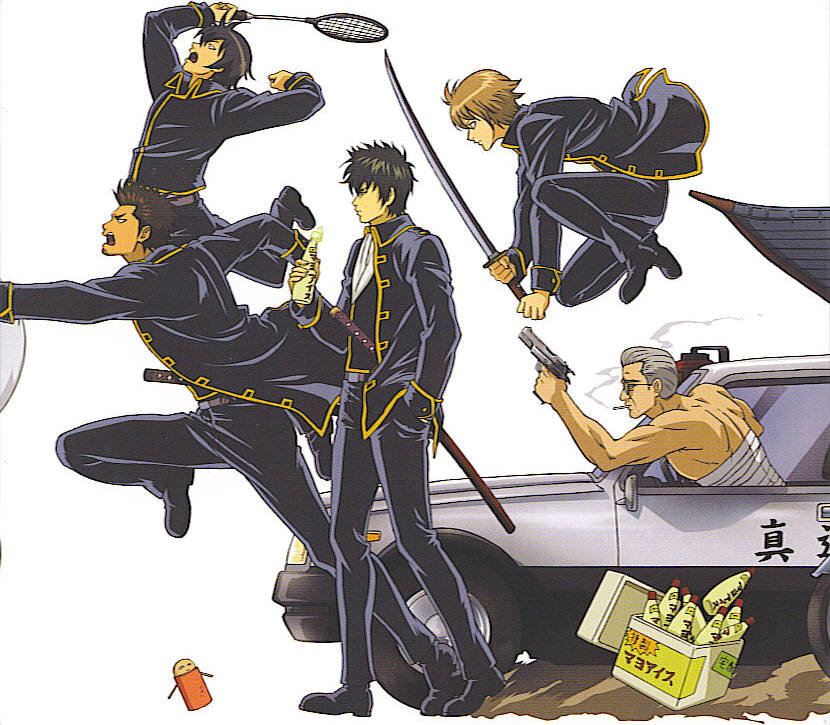 A series that makes use of all the Shinsengumi characters buts twists them almost beyond recognition is Gintama. Gintama is a unique series that falls into the category of 'historical science fiction'. It takes place in fuedal Japan, but a fuedal Japan that has been taken over by aliens. The Shinsengumi are acting as a police force for the alien conquerers and the people in power. The four Shinsengumi pictured here include Yamazaki (badminton racket), Kondou (running), Hijikata (with mayonaise) and Okita (katana). The series is a comedy of course, and it's main character, Sakata Gintoki, is frequently at odds with the Shinsengumi characters. Nothing here follows real historical events of course.


